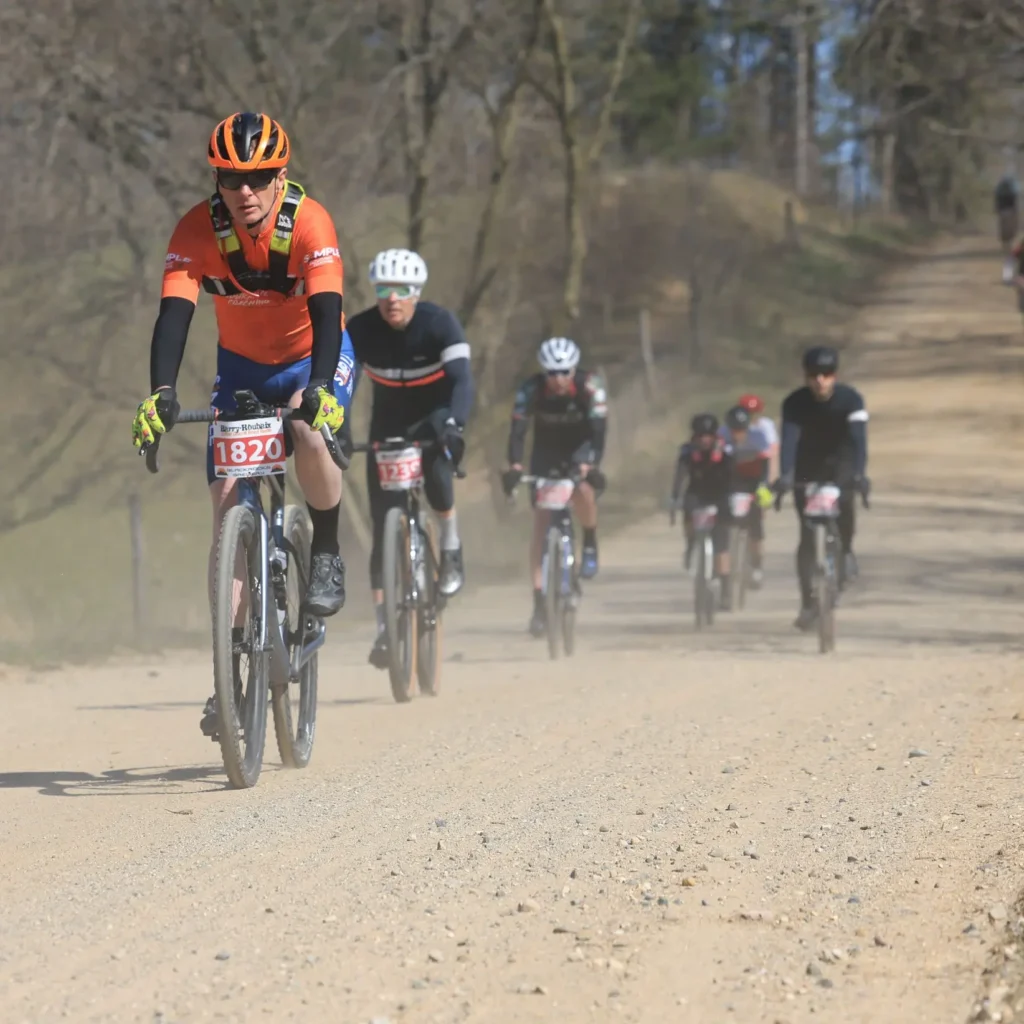
Your glycogen stores will empty between 90 minutes and three hours in a long gravel race.
It doesn’t matter how fit you are, doesn’t matter how perfectly you paced.
Without external fuel, you’ll be riding on fumes by the time the course really gets interesting.
The bonk doesn’t care about your FTP.
But here’s what’s wild: the solution is simple.
Not easy — simple.
You need about 50 to 80 grams of carbohydrates per hour once you pass the 90-minute mark.
In this article, we’ll discuss what the research says works, how to fuel without destroying your stomach, and a framework to calculate your race-day needs.
The Science: Why 50-80g Hits the Sweet Spot
Glycogen burns quickly but is limited — roughly 1,200-2,000 calories depending on your size, how fat adapted you are, and your training state.
During a four-hour gravel race at race pace, you may burn up to 600+ calories per hour.
Yet you can only absorb about 250 to 300 calories per hour from food.
There’s a deficit built in.
The question is whether you manage it or let it manage you.
Monash University research on endurance runners showed that consuming 76-90g of carbs per hour during three-hour exercise maintained blood glucose and significantly blunted glycogen depletion.
Athletes hitting 90g/hr showed 38 percent with breath hydrogen responses indicating malabsorption — meaning some people literally can’t absorb more than that without consequences.
The takeaway: 50-80g/hr sits in the effective window.
Below 50, you may be in a deficit.
Above 80, you’re risking GI distress for minimal added benefit.
The Formula: Your Hourly Carb Targets
| Race Duration | Effort Level | Carbs/Hour |
| 2-3 hours | Moderate | 40-55g |
| 3-4 hours | Gravel Race Pace | 55-70g |
| 4-6 hours | Hard Race Effort | 70-80g |
| 6+ hours | Ultra Distance | 80-120g |
The intensity multiplier matters.
A Zone 2 century needs less fuel than a 4-hour threshold effort.
Calorie burn per hour scales with intensity — your fueling should too.
Remember, these are always estimates.
You should test what works for you during long training rides.
Fuel Sources That Actually Work
The 1:1 glucose-to-fructose ratio is your friend.
This ratio uses two intestinal transport pathways (SGLT1 and GLUT5), allowing higher total absorption without overwhelming your gut.
I always use Formula 369 as my source for drink mix along with Embark Maple Syrup.
For variety: Mix solids (bananas, rice cakes) with liquids.
Different textures keep your palate fresh and your gut moving.
Timing: Fuel Early, Fuel Often
Start fueling at 30 to 45 minutes. Not hour two. Not when you feel hungry.
By the time thirst or hunger kicks in, blood glucose has already dipped.
You’re chasing the deficit.
Race-day rhythm:
- Pre-race (3-4 hrs): 2-3g carbs/kg, low fiber
- 30 min before: One gel + 200ml water
- 0-30 min: Sip electrolytes, focus on positioning
- 30+ min: Structured fueling — 15-20g every 15-20 minutes set to a timer
- Hour 3+: If fading, switch to liquids only.
Gut Training: Your Secret Weapon
Your gut adapts to what you train it to handle.
Protocol:
- Weeks 1-2: 40-50g/hr on easy rides
- Weeks 3-4: 60g/hr, mix of liquids and solids
- Weeks 5-6: 75g/hr, use race products only
- Weeks 7-8: Push to 90g/hr, test your ceiling
Rules:
- Never try new products on race day
- Log what works in training
- Back off if GI symptoms hit, rebuild gradually
Race Day: No Unknowns
- Pre-race meal practiced + proven. Avoid fats since they will delay carbohydrate absorption.
- Total carbs calculated (duration × rate)
- All products tested in training
- Backup fueling in case aid stations fail
- Set a timer for fueling intervals
Here are the three things you need to know about fueling a long-distance gravel race
1. Target 50-80 Grams of Carbs Per Hour. Start at 45 minutes — not when you feel hungry.
2. The Ratio: 1:1 Glucose-to-Fructose. Using both simultaneously = higher total absorption without overwhelming your gut.
3. Train Your Gut. Your gut adapts to what you practice. If you never eat on training rides, your gut won’t tolerate food on race day.
Need More?
Sign up for our free weekly newsletter where you’ll get these articles, plus links to our Athlete’s Compass podcast and other training tools.
Unlock the secrets to mastering gravel racing with our FREE Guide to Gravel Racing! Get yours here.
BOOK A DISCOVERY CALL so we can discuss your goals, answer questions, and talk about making your endurance training more effective, fun, and Simple.
Paul Warloski is a:
- USA Cycling Level 1 Advanced Certified Coach
- RRCA Running Coach
- Training Peaks Level 2 Coach
- RYT-200 Yoga Instructor
- Certified Personal Trainer
- Certified Nutrition Advisor