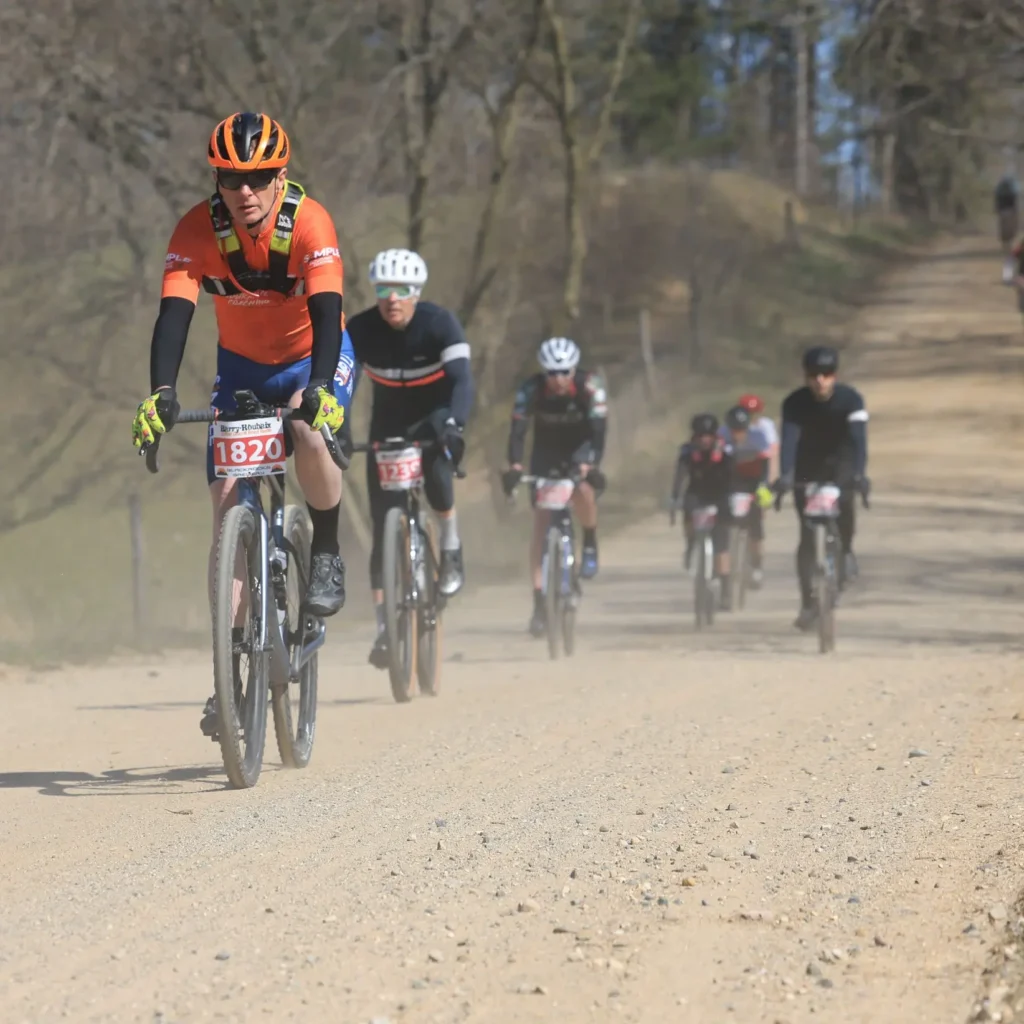
At some point in a long gravel race, you’ve wanted to quit.
Your legs felt terrible.
Nothing was feeling good.
Most gravel racers have felt this: Maybe you’ve had three flat tires, your shifting isn’t working correctly, and the group you were riding with disappeared up the road 20 minutes ago.
Or maybe nothing is actually wrong.
You’re simply tired.
The finish line is still 30 miles away, the next climb looks ridiculous, and you start asking yourself a dangerous question:
Why am I doing this?
Welcome to the mental game of gravel racing.
Gravel races are physically demanding.
We spend months training our aerobic system, improving our threshold, building strength, and practicing nutrition.
But gravel racing also requires the ability to solve problems, manage emotions, and keep moving forward when the race stops going according to plan.
And at some point, almost every long gravel race stops going according to plan.
Gravel Racing Is a Series of Problems to Solve
One of the biggest mental mistakes we can make is expecting race day to go perfectly.
It probably won’t.
Your nutrition plan may work beautifully for the first four hours and then suddenly every gel tastes disgusting.
You might drop a bottle.
The aid station might not have the food you expected.
Your power meter might stop working.
You could flat.
You could miss a turn.
The weather could change.
Or you might simply have a bad hour.
None of these things automatically end your race.
They simply create a new problem to solve.
I like to think about gravel racing as a series of decisions.
What’s happening right now?
What can I control?
What’s the next best decision I can make?
You don’t have to solve the entire race.
You only have to solve the problem in front of you.
Stop Racing the Entire Distance
Imagine you’re 70 miles into a 100-mile gravel race.
You’re tired.
Your back hurts.
You’re struggling to eat.
Then you look at your bike computer and realize you still have 30 miles to ride.
That’s a lot for your brain to process.
The temptation is to mentally race all 30 of those miles at once.
You start thinking about the climbs coming later. You calculate how many hours you have left.
You wonder how bad your legs will feel at mile 80.
None of those problems exist yet.
Your job is to get to the next aid station.
Or the next town.
Or the top of the next climb.
Sometimes your goal might simply be to ride for another 10 minutes.
Breaking a long event into smaller pieces makes the race mentally manageable.
I’ve worked with athletes who use aid stations as checkpoints. Others focus on mileage markers. Some divide the race into hours.
The exact strategy doesn’t matter.
The goal is to stop asking, “Can I ride another 30 miles?”
Instead ask, “Can I keep moving for the next 10 minutes?”
Most of the time, the answer is yes.
Your Brain Gets Negative When You’re Tired
One of the most important things to understand about endurance racing is that your thoughts aren’t always reliable late in a race.
Fatigue changes your perspective.
So does hunger.
So does dehydration.
When your energy is low and your body is under significant stress, small problems can suddenly feel enormous.
A minor mechanical becomes a catastrophe.
A bad 20-minute stretch becomes proof that your entire race is ruined.
Getting dropped by a group becomes evidence that you aren’t fit enough.
You start creating stories.
I’m having a terrible race.
I didn’t train enough.
Everyone else is stronger than me.
I’m never doing this again.
Before you believe those thoughts, check the basics.
Have you eaten?
Have you had enough fluids?
Are you overheating?
Have you been riding too hard?
Can you back off for 10 or 15 minutes?
Sometimes the best mental strategy is a bottle of carbohydrates and a slightly easier pace.
Separate Discomfort From Danger
Gravel racing is uncomfortable.
Your legs will hurt.
Your hands might hurt.
Your neck and back might get tired.
You’ll probably experience moments when you desperately want to stop pedaling.
Discomfort doesn’t necessarily mean something is wrong.
One skill experienced endurance athletes develop is learning the difference between this is hard and this is dangerous.
Sharp or sudden pain, symptoms of heat illness, significant dizziness, confusion, chest pain, or a bike that is unsafe to ride require a different decision.
But tired legs?
A hard climb?
A headwind?
Feeling generally miserable at hour five?
Those may simply be part of the experience.
Ask yourself:
Is this a problem I need to stop for, or is this discomfort I can manage?
That’s an important distinction.
Have a Plan for the Moment You Want to Quit
Don’t wait until you’re exhausted to decide what you’ll do when you want to quit.
Make that decision before the race.
Create a simple quitting protocol.
For example:
- Eat something.
- Drink.
- Slow down.
- Get off the bike for five minutes if necessary.
- Check the bike.
- Give yourself 20 minutes before making a decision.
Unless you’re injured, sick, or in an unsafe situation, avoid making major decisions during your worst moment.
I’ve seen athletes go from completely defeated to riding reasonably well again after eating, drinking, and backing off the pace.
A bad moment doesn’t always mean you’re having a bad race.
Sometimes it’s simply a bad moment.
Give yourself the opportunity to recover before deciding your race is over.
Control the Things You Can Control
Gravel racing creates a lot of uncertainty.
You can’t control the weather.
You can’t control the wind.
You can’t control whether another rider crashes in front of you.
You can’t control the condition of the roads.
You can’t control whether the fastest riders in your age group show up.
But you can control your effort.
You can control your fueling decisions.
You can control how you respond to a mechanical problem.
You can control whether you panic or start solving the problem.
When things start going wrong, bring your attention back to the things you can actually influence.
I sometimes encourage athletes to ask three questions:
What is happening?
What can I control?
What is my next action?
Maybe the next action is eating.
Maybe it’s slowing down.
Maybe it’s fixing a tire.
Maybe it’s relaxing your shoulders and taking a few slow breaths.
Action gives your brain something productive to do.
Talk to Yourself Like a Coach
Pay attention to how you talk to yourself during a difficult race.
Most of us would never talk to an athlete or training partner the way we sometimes talk to ourselves.
You’re terrible at this.
You blew it again.
You should quit.
That’s not being a friend.
And it isn’t particularly useful.
Good self-talk doesn’t mean pretending everything is wonderful.
You don’t have to tell yourself you’re feeling amazing when you’re clearly not.
Instead, use realistic and useful language.
This is a hard section.
Back off and eat.
Stay patient.
Get to the next aid station.
I’ve had bad moments before and recovered.
Keep moving.
Your internal voice should give you direction.
Talk to yourself the way you would talk to an athlete you’re coaching through a difficult moment.
Remember Why You Signed Up
At some point, your training metrics won’t matter.
Your FTP won’t motivate you.
Your VO2max won’t care that you’re tired.
The workout you completed three months ago won’t magically push you over the next climb.
That’s when your reason for being there becomes important.
Why did you sign up for this race?
Maybe you wanted to see what you were capable of doing.
Maybe the event has been on your bucket list for years.
Maybe you’re racing with friends.
Maybe you’re coming back from an injury or a difficult period in your life.
Maybe you simply wanted a challenge.
Your reason doesn’t need to be profound.
But it should mean something to you.
Before the race, spend some time thinking about why this event matters.
Write it down.
When the race gets difficult, remind yourself.
Motivation is easy at the starting line.
Your reason for racing becomes much more important eight hours later on a lonely gravel road.
Find Some Joy in the Ridiculousness
Gravel racing can be absurd.
You’re riding a bicycle for an unreasonable number of hours on roads that occasionally seem inappropriate for bicycles.
You’re eating potatoes out of a plastic bag.
You’re covered in dust or mud.
Your friends are discussing tire pressure with an intensity normally reserved for international diplomacy.
Sometimes you need to notice how ridiculous and wonderful the whole thing is.
Look around.
Talk to another rider.
Thank an aid station volunteer.
Notice the scenery.
Laugh when something doesn’t go perfectly.
Joy doesn’t eliminate fatigue.
But it can change your relationship with the experience.
We train hard because we care about our performance.
But most of us started riding bikes because riding bikes is fun.
Don’t completely lose that person on race day.
Mental Strength Is a Skill You Can Practice
You don’t suddenly become mentally strong on race day.
You practice these skills during training.
Long rides give you opportunities to notice negative thoughts.
Hard intervals teach you how to stay focused when you’re uncomfortable.
Bad weather teaches adaptability.
Training rides with small problems teach you how to solve them without panicking.
You can even intentionally practice your mental strategies.
During a difficult training ride, ask: What can I control?
Practice breaking the ride into smaller segments.
Use your race-day self-talk.
Remind yourself why you’re training.
Mental skills are training skills.
The more you practice them, the easier they are to access when you’re tired.
You Don’t Have to Feel Motivated to Keep Moving
Here’s one of the biggest lessons I’ve learned from endurance sports:
You won’t always feel motivated.
Motivation comes and goes.
Sometimes you’ll feel strong, confident, and excited.
An hour later you might be questioning every decision that brought you to that gravel road.
You don’t need to wait for motivation to return.
You can simply make the next good decision.
Eat.
Drink.
Slow down.
Fix the problem.
Ride to the next checkpoint.
Keep moving.
The mental game of gravel racing isn’t about becoming fearless, endlessly positive, or tougher than everyone else.
It’s about staying present and making good decisions when things get difficult.
Because during a long gravel race, things will get difficult.
The question isn’t whether you’ll face a hard moment.
The question is what you’ll do when that moment arrives.
Solve the problem in front of you. Make the next good decision. And keep moving forward.
Three Things You Should Know About the Mental Game of Gravel Racing
- You don’t have to solve the entire race. When the distance feels overwhelming, focus on the next climb, aid station, or 10 minutes. Make the race mentally smaller.
- Don’t make big decisions during your worst moment. Eat, drink, slow down, and give yourself time to recover before deciding your race is over. A bad moment doesn’t always mean a bad race.
- You don’t have to feel motivated to keep moving. Motivation will come and go during a long gravel race. Focus on making the next good decision, solving the problem in front of you, and continuing forward.
Need More?
Sign up for our free weekly newsletter where you’ll get these articles, plus links to our Athlete’s Compass podcast and other training tools.
Unlock the secrets to mastering gravel racing with our FREE Guide to Gravel Racing! Get yours here.
BOOK A DISCOVERY CALL so we can discuss your goals, answer questions, and talk about making your endurance training more effective, fun, and Simple.
Paul Warloski is a:
- USA Cycling Level 1 Advanced Certified Coach
- RRCA Running Coach
- Training Peaks Level 2 Coach
- RYT-200 Yoga Instructor
- Certified Personal Trainer
- Certified Nutrition Advisor