by Coach Anthony James
If you’re showing up to an Arkansas gravel event with the same tire setup you’d use in Kansas or Colorado, you’re already behind.
Here’s the thing—most gravel racing advice out there assumes you’re riding smooth, rolled crusher dust on endless country roads.
That’s fine for the Great Plains. It’s great for the Midwest.
But Arkansas? Arkansas doesn’t play by those rules.
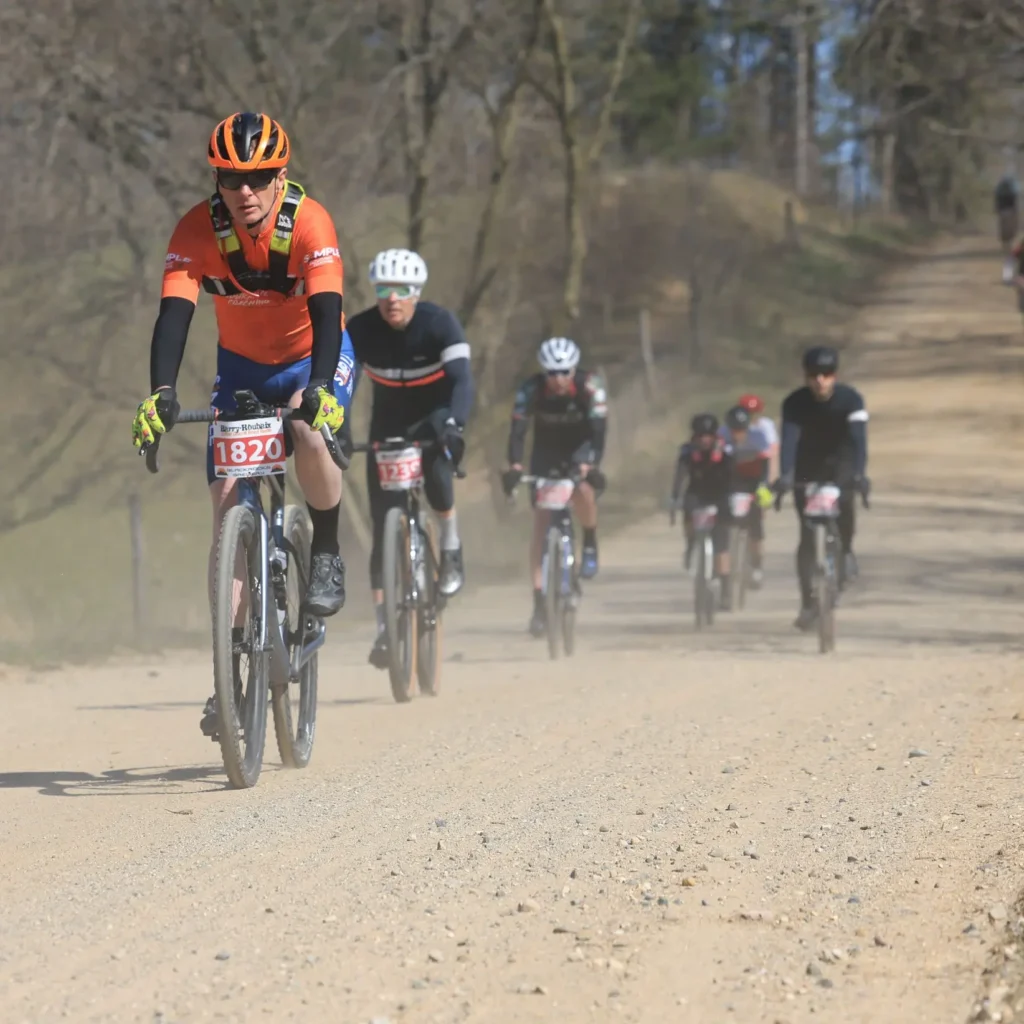
The Ozarks and Ouachitas are throwing rocky, steep, technical terrain at you that was built for mountain bikes, not drop-bar bikes.
The gravel is sharp. The climbs are sustained and ugly. The descents are chunky enough to destroy sidewalls.
And the whole time, you’re dealing with mixed surfaces that would feel more at home on a trail ride than a gravel race.
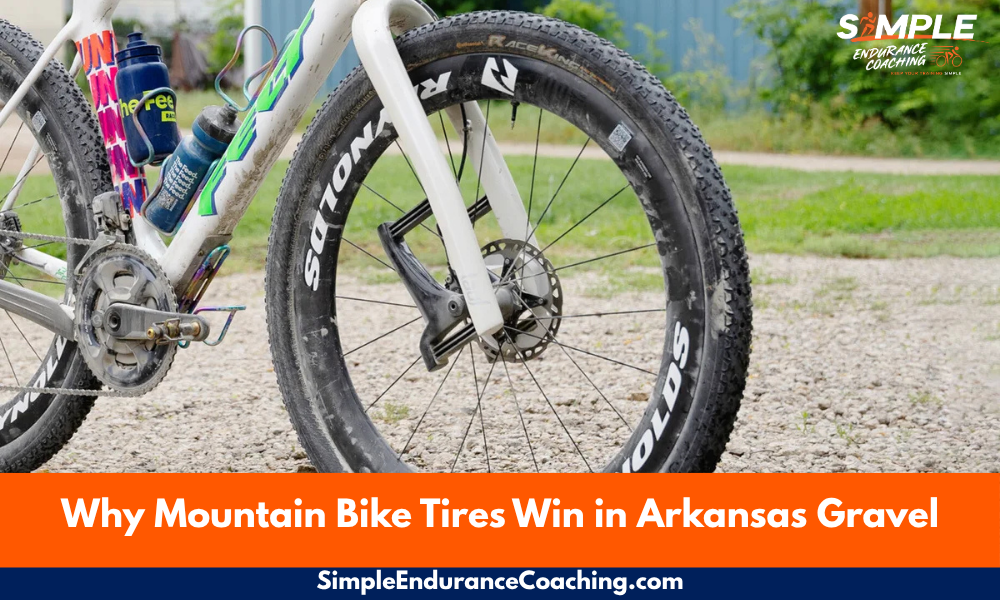
The secret most riders figure out too late? Wider isn’t slower here—it’s faster.
MTB-width tires (50-57mm) absorb the vibration that kills your speed on rough rock. They hold traction on loose, steep climbs where narrower tires wash out. They protect your sidewalls from the sharp stuff that leaves other riders stranded by the side of the road. And they keep you composed when fatigue sets in and the technical difficulty ramps up in the final miles.
This isn’t about being conservative. It’s about being smart. In Arkansas, the race isn’t won on the smooth opening miles, it’s lost or won in the last 20 when your hands are shaking, your lines get sloppy, and the terrain turns ugly.
So let’s dig into why 50-57mm tires make sense for Arkansas gravel, event by event, and why the logic here is completely different from everywhere else.
Why Arkansas Gravel Is Fundamentally Different
- Rugged Ozark and Ouachita terrain with sustained climbing, sharp rock, and steep pitches (Hazel Valley Rally, Rule of Three, Highlands Gravel Classic)
- Mixed‑surface design baked into the events (tarmac + gravel + singletrack), not as connectors but as decisive terrain (Rule of Three, Hazel Valley Rally)
- Sharp, sidewall‑hostile gravel and forest roads, frequently emphasized by organizers and participant descriptions (Rule of Three, Hazel Valley Rally)
- Late‑race technical difficulty, where fatigue and bike handling—not aerobic capacity—decide outcomes (Rule of Three, Hazel Valley Rally)
This contrasts sharply with:
- Kansas / Great Plains events (e.g., Unbound): long, open roads, sustained tempo, fewer technical features
- Upper Midwest gravel: smoother farm roads, less rock density
- Western alpine gravel: altitude and climbing dominate more than surface violence
Arkansas gravel is not “road‑like gravel.” It is underbiked MTB terrain presented as gravel.
Event‑Specific Terrain Profiles (Why 50–57 mm Fits)
Hazel Valley Rally (Ozark National Forest)
- Up to 70% gravel roads, but mountain gravel with long, steep climbs and sharp rock
- Up to 6,500 ft of climbing on the long route
- Repeatedly described as “most demanding” gravel in Northwest AR
Why 50–57 mm works here
- Larger volume smooths repeated sharp impacts on sustained climbs
- Lower pressure improves traction on loose, steep grades
- Stronger MTB‑derived casings reduce cut risk in forest rock
This is terrain where fatigue‑induced line mistakes are expected, not exceptional.
Rule of Three (Bentonville / Bella Vista)
- Explicit mix of tarmac, gravel, and extended singletrack
- Organizers warn of sidewall tears and “chossy, chunky, sharp” gravel
- Singletrack appears scatter to at times late in the race, after riders are depleted
Why 50–57 mm works here
- Singletrack performance becomes decisive, not optional
- Wider tires maintain braking and cornering control when exhausted
- Riders lose less time dabbling, walking, or braking excessively
Rule of Three is a handling‑limited race, not a watts‑limited one.
Arkansas Graveler (Statewide / Multi‑day)
- Traverses Ozarks + Delta, shifting from mountainous gravel to flat but often loose or washboarded farm roads
- About 50/50 paved and gravel, with huge daily variability
- Riders are encouraged to prioritize durability and comfort over speed
Why 45–50 mm works here for 2026 (Routes Vary Year To Year)
- Pressure flexibility across radically different surfaces
- Reduced cumulative fatigue over multiple days
- Better tolerance for rough rural roads and inconsistent maintenance
This event explicitly welcomes mountain bikes and discourages road bikes, reinforcing the terrain reality.
Arkansas vs Other Gravel Regions (Why the Logic Changes)
| Region | Typical Gravel Character | Tire Optimization |
| Kansas / Plains | Long, straight, rolling farm roads | Speed + aero |
| Upper Midwest | Smoother crushed gravel | Mid‑width efficiency |
| Western Alpine | Long climbs, altitude | Weight + gearing |
| Arkansas | Sharp rock, steep grades, singletrack | Control + durability |
Arkansas events routinely combine:
- MTB‑grade surfaces
- Long gravel climbs
- Technical descents
- Mixed‑terrain transitions
That combination punishes narrow tires disproportionately compared to smoother regions.
Why 50–57 mm Is Often Faster Overall in Arkansas
Modern gravel research shows wider tires can match or exceed narrower ones on rough terrain by reducing vibration losses.
In Arkansas specifically:
- Vibration losses are high due to sharp rock and uneven surfaces
- Braking losses are high due to steep, technical descents
- Handling losses increase dramatically as fatigue accumulates
Wider tires reduce all three.
For amateurs, this usually results in:
- Higher average speed
- Fewer stops
- Lower DNF risk
- Stronger finishes
Pavement Tradeoff (Why Arkansas Still Favors Width)
Arkansas events include pavement, but:
- Pavement is often rolling, broken, or short‑lived
- Drafting opportunities collapse quickly due to terrain
- Time gaps open on gravel and trail, not asphalt
The time lost on pavement with 50–57 mm tires is usually recovered—and exceeded—on technical sectors.
Sidewall Protection Is Strategic, Not Conservative
Both Hazel Valley Rally and Rule of Three explicitly emphasize rugged gravel and sharp rock.
MTB‑width tires:
- Have thicker sidewalls
- Tolerate lower pressures
- Resist pinch cuts and rock strikes
In Arkansas, mechanical survival is part of race strategy.
Bottom Line (Arkansas‑Specific)
Across Hazel Valley Rally, Rule of Three, Arkansas Graveler, and most AR gravel events:
50–57 mm tires make sense because Arkansas gravel is:
- Sharper
- Steeper
- More technical
- More fatiguing
- More mechanically demanding
Arkansas events are not decided by who rolls fastest on smooth gravel—they are decided by who loses the least time on brutal terrain late in the day and suffers the least amount of mechanicals.
Three Things to Know About Running Mountain Bike Tires for Arkansas Gravel
1. Wider = Faster
On Arkansas rock and chunk, 50-57mm tires maintain higher average speeds than narrower tires.
2. Arkansas Punishes Narrow Tires
Steep climbs + loose surfaces + late-race fatigue = your setup matters more here than anywhere else.
3. Survival = Strategy
MTB-width tires aren’t a compromise—they’re how you finish.
Coach Anthony James is a USA-Cycling Level 3 coach based in Arkansas. He specializes in mountain bike training and skills work as well as gravel racing. He can be reached at [email protected].