How to train your mind as hard as your body so you can finish strong
There’s a moment, or maybe more than one, in every long gravel event – you know the one.
The legs are fine.
The fuel is there.
But somewhere around mile 60 (or 80, or 100), a voice starts whispering: You can’t do this. You’re done. This is stupid.
Here’s the truth: that voice isn’t your body talking.
It’s your mind running out of steam.
The science is clear: your brain is command central.
When it says you’re done, you’re done, even if your muscles still have plenty left in the tank.
That’s why training your mind isn’t some fluffy “nice to have.”
It’s a performance tool as critical as your power meter or your nutrition plan.
Research suggests that athletes who practiced self-compassion had lower heart rates, more energy, and a lower sweat response compared to when they were self-critical.
In other words: negativity literally wastes energy and makes a hard situation even harder.
So let’s get practical: Here’s how to build mental toughness that matches your physical fitness.
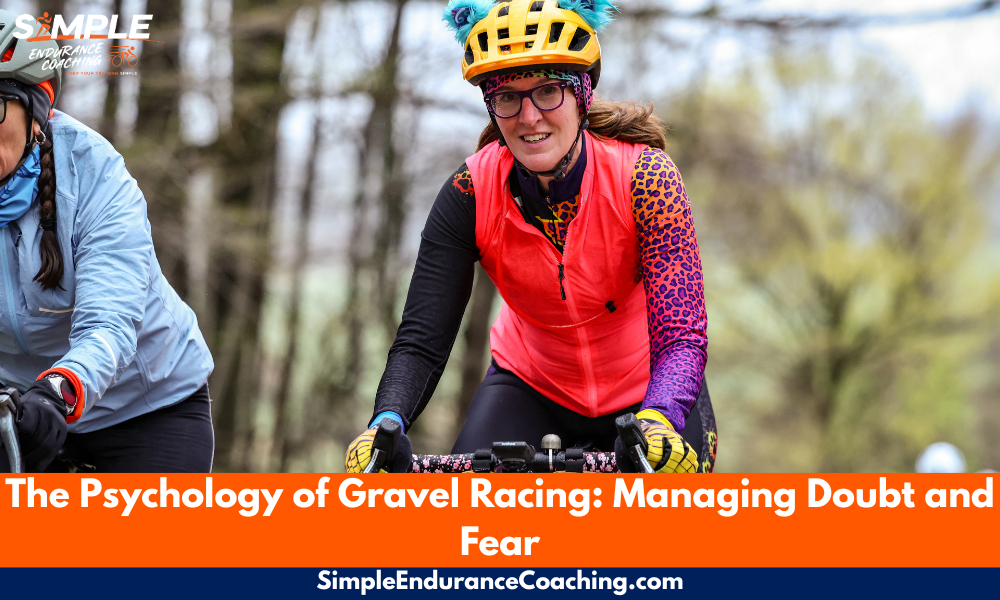
Managing Doubt and Fear
Doubt and fear are normal. Every rider—beginner to pro—faces them.
The difference is how you respond.
1. Catch the Gremlin Early
Your inner dialogue is always with you, and it affects performance.
When the voice says “I suck at hills” or “I’m too slow,” that’s not neutral observation, that’s your brain piling on.
The fix: Notice the thought, then reframe it.
Instead of “I hate climbs,” try “This is where I separate myself from the pack” or simply “Keep turning the pedals.”
2. Create “Anchor Phrases”
You might try creating specific mantras for different race moments:
- Early race: “Strong and smooth.”
- The tough middle miles: “A mile at a time.”
- On climbs: “One pedal stroke at a time.”
3. Use Visual Cues on Your Bike
There’s a reason marathon crowds hold signs, they work.
Research showed that cyclists pedaled 3-5 minutes longer when happy subliminal messages (smiley faces, positive words like “go”) were flashed on a screen compared to negative messages.
Try this: Tape a small note to your top tube with a key phrase or even a photo that makes you smile.
At gravel races, you’ll see riders with jokes, race stickers, and encouragement scrawled on their bikes for exactly this reason.
Handling the Low Moments
Every long event has a “dark moment.”
For some, it’s mile 40. For others, it’s mile 90.
The key is knowing it’s coming—and having a plan.
Recognize Cognitive Fatigue
Research on cognitive fatigue in endurance sports shows that your mind tires before your body.
Signs include:
- Losing focus on simple tasks (forgetting to eat, missing a turn)
- Sudden drops in self-belief despite good performance
- Everything feeling harder than it should
- Impulsive decisions or emotional reactions
When you notice these, pause. Breathe. Reset.
The “Chunk It Down” Strategy
When the distance feels overwhelming, break it into smaller pieces.
Don’t think about 100 miles.
Think about the next mile. The next mile marker. The next five minutes.
Your brain can handle short, manageable segments even when it can’t handle the whole picture.
Smile—Even When You Don’t Feel Like It
Research found that runners who smiled used less oxygen, improved running economy by nearly 3%, and reported lower perceived exertion compared to those who frowned.
You won’t feel like grinning for eight hours.
But periodically looking up, taking a breath, and smiling, even at the absurdity of what you’re doing, will make the effort feel easier.
Building Confidence Through Preparation
Confidence isn’t fake positivity.
It’s built on evidence.
Here’s how to stack the deck in your favor:
1. Train Your Brain Like You Train Your Body
Self-talk keeps you engaged, present, and even amused when things get dark.
Practice self-talk during training, not just races.
When you’re on a hard interval or a tough climb, run through your phrases.
Build the habit now so it’s automatic on race day.
2. Visualize Success—Specifically
Research confirms that athletes with stronger imagery abilities tend to achieve at higher levels.
A six-month guided imagery intervention in one study significantly improved both imagery ability scores and actual performance.
How to visualize effectively:
- Find a quiet space and close your eyes.
- Imagine the race in vivid detail: the terrain, the weather, the sounds.
- Picture yourself handling the hard moments—climbing a steep grade, grinding through loose gravel, staying calm when fatigue sets in.
- Include sensory details: the vibration through your handlebars, the taste of your hydration, the sound of your tires on the surface.
The more specific, the better. You’re not just hoping for success—you’re rehearsing it.
3. Practice Race-Like Conditions
Build your “grit” by incorporating difficult situations into training.
Bad weather rides, tough terrain, back-to-back hard days, these aren’t just physical preparation.
They’re mental rehearsal.
When you’ve already survived hard things in training, race-day challenges feel familiar rather than terrifying.
4. Trust Your Process
After 23 years teaching middle schoolers and now coaching endurance athletes, I’ve learned this: confidence comes from preparation, not perfection.
You’ve done the training.
You’ve built your fitness.
Trust that the work you’ve put in will show up when you need it.
The Bottom Line
Gravel racing will ask you to suffer.
It will ask you to doubt yourself.
There will be moments when the voice in your head says “stop.”
But here’s what I know from working with athletes for over two decades: the mind gives up before the body has to.
When you train your mental game with the same seriousness as your physical training, you become the athlete who can push through the dark miles.
You become the rider who finishes strong when others fade.
Your brain is the engine that drives everything else.
Train it accordingly.
What mental strategies have helped you through the tough moments in races? Drop a comment below—I’d love to hear what’s working for you.
Three Things You Should Know About the Psychology of Gravel Racing
1. Your mind gives up before your body.
Cognitive fatigue is real. The “dark moments” in gravel races are usually mental battles, not physical ones.
2. Self-talk works.
Cyclists who practiced positive self-talk improved time to exhaustion by 18%. Create mantras. Catch the negative voice. Reframe it.
3. Smile—it actually helps.
Research shows smiling lowers oxygen consumption and reduces perceived effort. Frowning does the opposite.
Need More?
Unlock the secrets to mastering gravel racing with our FREE Guide to Gravel Racing! Get yours here.
BOOK A CALL so we can discuss your goals, answer questions, and talk about making your endurance training more effective, fun, and Simple.
Paul Warloski is a:
- USA Cycling Level 1 Advanced Certified Coach
- RRCA Running Coach
- Training Peaks Level 2 Coach
- RYT-200 Yoga Instructor
- Certified Personal Trainer
- Certified Nutrition Advisor