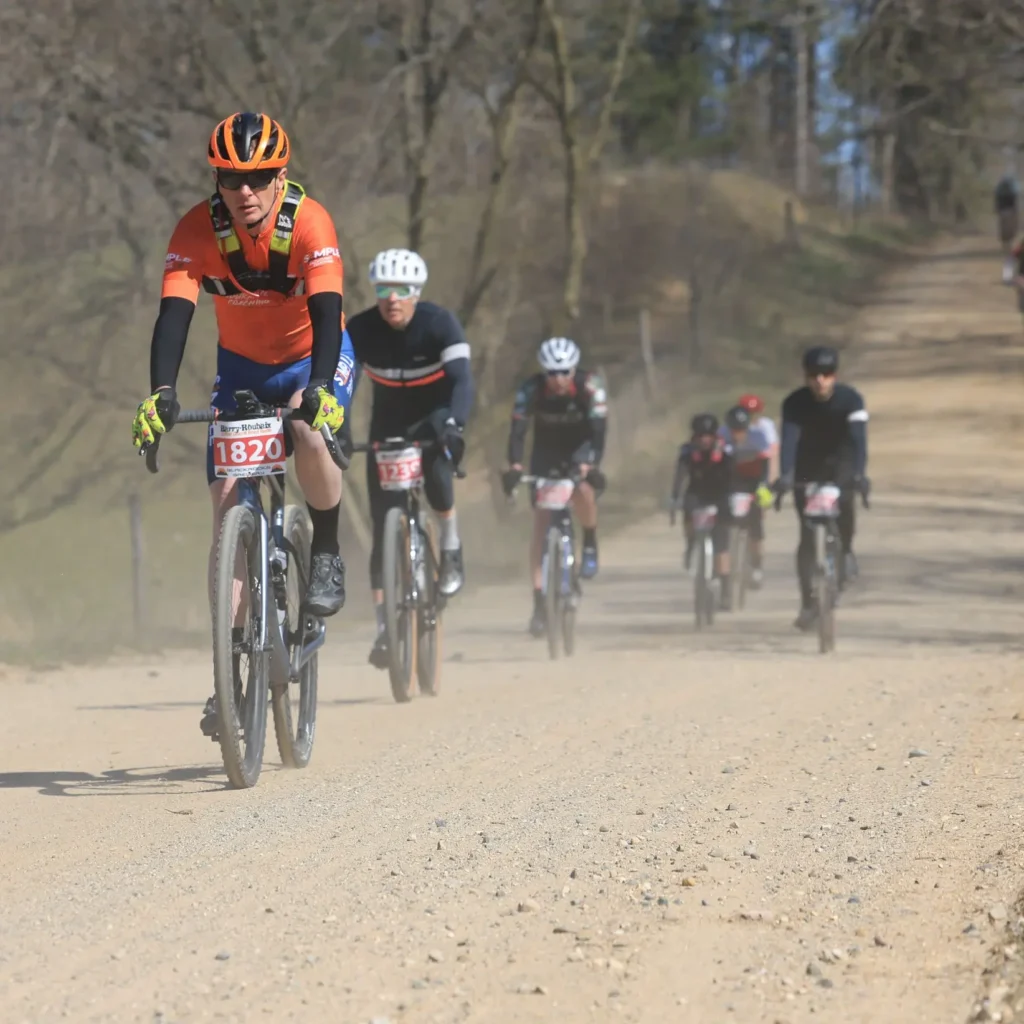
How to train your body to process calories at high rates—without losing your lunch
by Coach Paul Warloski
Ann Trason, 14-time Western States winner, reportedly said that ultra marathons are “an eating and drinking competition with a little running in between.”
She’s not wrong.
But here’s the problem: you know you need to fuel, yet every time you try to eat during a long effort, your stomach rebels—nausea, cramping, that dreaded urgent bathroom stop mid-race.
The same battle happens on the bike.
Some gravel riders hitting hour six of a 100-mile race discover their gut has never processed food for that long at race pace.
Cyclists grinding up long climbs while technically navigating chunky terrain realize eating while focused on survival is its own skill.

The Good News: Your Gut Can Be Trained
Here’s the game-changer: your gut can be trained.
Just like your cardiovascular system adapts to interval training, your digestive system can learn to tolerate and absorb more carbohydrate.
Research shows athletes who underwent just two weeks of structured gut training reduced GI symptoms by around 60 percent, and improved performance in follow-up tests.
We’ll talk about how to train your gut for both ultra-running AND gravel riding, the most common GI issues endurance athletes face, and what science says about carbohydrate tolerance.
The Gastrointestinal Puzzle: What’s Actually Going On Down There
Before we fix it, let’s understand the problem.
Your GI tract runs from mouth to anus, and its job is breaking down food, absorbing nutrients, and eliminating waste.
Sounds simple.
But during prolonged exercise, this system faces serious challenges:
- Reduced blood flow: Up to 80 percent of gut blood flow shunts to muscles during intense effort
- Delayed gastric emptying: Food sits in your stomach longer, causing fullness and nausea
- Mechanical stress: Repeated impact (especially running) jostles your intestines
- Thermal strain: Heat compounds GI distress significantly
- Dehydration: Makes everything worse. Thicker blood means less delivery to digestive organs
The result?
GI symptoms affect 30-90% of distance runners, 30-50% of participants in exhausting endurance events, up to 93% in long-distance triathletes, 37-89% in runners competing in 67-161 km races, 70% in elite endurance athletes, and 4% in marathon running (mild) up to 32% in Ironman (severe).
You’re not alone if you’ve ever vomited mid-race or desperately searched for a porta-potty at mile 50, or bonked hard at hour 80 on a century ride.
Common GI Symptoms Athletes Experience
| Upper GI | Lower GI |
| Nausea | Abdominal cramping |
| Vomiting | Diarrhea |
| Heartburn | Urge to defecate |
| Belching | Bloating |
| Fullness | Gas |
| Acid reflux | Constipation |
Sport-Specific Gut Challenges
Running:
- High-impact repetition increases intestinal permeability
- Longer aid station gaps in ultras (sometimes 10-20+ miles)
- Can’t consume calories while running technical terrain
- Full body movement makes eating awkward
Gravel Riding:
- Technical terrain makes eating while riding difficult
- Races often longer than training rides (8-10 hours vs 4-5 hours)
- Aid stations may be 40-50 miles apart
- Sustained effort at race pace limits eating windows
- Heat from pavement compounds dehydration
The Science of Gut Training: What Actually Works
Here’s where it gets interesting. The research on gut training shows real promise, but it’s not magic.
The Costa Studies (The Gold Standard)
In two landmark studies, researchers put 25 recreational runners through a two-week gut-training protocol:
- Baseline test: 2 hours steady-state running + 1-hour distance test
- Carb intake: 30g every 20 minutes = 90g/hr (that’s a lot)
- Results at baseline: 100% reported moderate symptoms, 52% reported severe symptoms
Then participants completed ten 1-hour running sessions over 14 days while consuming their assigned carb product. After just two weeks:
- Carb groups: 60 percent reduction in GI symptoms
- Performance gains: Significant improvement in the 1-hour distance test
- Placebo group: Only 18% symptom reduction (not statistically significant)
The takeaway: Repeated exposure to high carbohydrate intake during exercise does improve tolerance.
Your gut adapts.
This applies to cyclists too—same physiology, same mechanism.
The gut doesn’t care if you’re running or riding; it only cares about intensity, duration, and carbohydrate load.
Why Carbohydrate Blend Matters
Here’s something many athletes get wrong: you need multiple transportable carbs when going above 60g/hr.
| Carb Type | Transporter | Absorption Limit |
| Glucose | SGLT1 | ~60g/hour |
| Fructose | GLUT5 | Beyond glucose limit |
The SGLT1 transporter maxes out around 1g per minute (60g/hr).
Beyond that, you need fructose to use a different pathway.
This is why most elite athletes use 2:1 glucose-to-fructose ratios for high intake:
- 90g/hr = 60g glucose + 30g fructose
- 100g/hr = 60g glucose + 40g fructose
Pro tip: Maltodextrin = glucose. Sucrose = 50/50 glucose/fructose. High-fructose corn syrup = 50/50 blend.
Your Step-by-Step Gut Training Framework
Now for the practical part.
Here’s how to actually build gut tolerance—whether you’re training for a 100-mile ultra or a gravel century:
Phase 1: Preparation (2+ weeks before starting)
- Increase carbohydrate-rich foods in daily diet
- Focus on low-fiber, low-fat options around training: rice, pasta, sourdough, oatmeal, potatoes, bananas, applesauce
- Aim for 3-5g carbs/kg on light days, 6+g carbs/kg on heavy training days
- This alone starts training your gut
Phase 2: Structured Gut Training (8-12 weeks before key race)
| Week | Task | Carb Intake |
| 1 | Baseline dose (what you can tolerate) | 30-45g/hr |
| 2-3 | Progress if tolerated | +10-15g/hr |
| 4-5 | Continue progression | +10-15g/hr |
| 6-7 | Identify max tolerable dose | Push to 60-90g/hr |
| 8-9 | Optional: push 10% above max, then come back | +10-20% |
| 10-12 | Taper down to max tolerable dose | 70-90g/hr |
Sport-Specific Execution
For Ultra Runners:
- Fuel from minute one—glycogen stores deplete faster than you think
- Practice eating while running on varied terrain
- Train your gut for the specific aid station foods you’ll use
- Back-half nutrition often needs simplification: transition to liquids
For Gravel Riders:
- Front-load calories in easier sections—you can’t eat while climbing technical terrain
- Practice eating while handling the bike, not just in easy spins
- Long rides (4+ hours) should mirror race conditions exactly
- Watch gut sensitivity increase around hour 5+; simplify accordingly
Key Guidelines (Both Sports)
- Fuel early: Start within first 15-20 minutes of each session
- Frequency: Minimum three gut-training sessions per week
- Mimic race conditions: Match intensity, duration, and environment to your goal event
- Stay hydrated: Dehydration impairs gut emptying and carb absorption
- Use race-day products: Gels, chews, drinks—whatever you’ll use on race day. Test before, not during.
Signs You’re Overdoing It (And Why That’s Actually Good)
Gut training isn’t comfortable.
You’ll likely hit some discomfort.
But distinguishing “training adaptation” from “going too far” matters:
Normal adaptation (good):
- Mild bloating
- Slight gas
- Minor stomach rumbling
Red flags (ease back):
- Nausea
- Vomiting
- Diarrhea
- Strong cramping
- Feeling overly full for hours
Here’s the truth: those uncomfortable signs actually help you find your gut’s current capacity.
It’s the same progressive overload principle you apply to physical training.
Push slightly beyond comfort, then back off.
That’s how adaptation happens.
What About Fructose and Gut Health?
There’s ongoing debate here.
Some athletes experience GI distress specifically from fructose, especially in large quantities or when combined with certain foods.
If you notice issues:
- Reduce fructose-only products
- Stick to glucose-dominant options at lower intake
- Test your tolerance during training before assuming blame
The key is individualization.
What works for one athlete’s gut completely disrupts another’s.
Your training will reveal your limits.
The Bottom Line
- GI symptoms affect the majority of endurance athletes in every sport—you’re not broken, you’re normal
- Your gut adapts to carbohydrate training through repeated exposure
- Start 8 to 12 weeks out, progress gradually, and fuel from minute one
- Use glucose + fructose blends above 60g/hr
- Practice with race-day products in training
- Find YOUR tolerable dose, more isn’t always better
- The principles are universal, but execution differs: front-load calories on the bike, practice eating while running, know your aid station gaps, and train for the specific duration of your event
Ready to build your race-day fueling plan?
Start with two weeks of increased daily carbs, then add one gut-training session per week to your schedule.
Track what you eat, when you eat it, and how your gut responds.
That data is gold for race day.
Three Things to Know About Gut Training for Long Races
1. Your gut adapts—just like your legs. Two weeks of consistent carb training cuts GI symptoms nearly in half.
2. Two transporters > One transporter. Above 60g/hr, you need both glucose AND fructose to absorb more without GI distress.
3. Practice like race day. Train long, use race products, and master eating on the bike or over technical terrain—or you’ll learn the hard way on race day.
Need More?
Sign up for our free weekly newsletter where you’ll get these articles, plus links to our Athlete’s Compass podcast and other training tools.
Unlock the secrets to mastering gravel racing with our FREE Guide to Gravel Racing! Get yours here.
BOOK A CALL so we can discuss your goals, answer questions, and talk about making your endurance training more effective, fun, and Simple.
Paul Warloski is a:
- USA Cycling Level 1 Advanced Certified Coach
- RRCA Running Coach
- Training Peaks Level 2 Coach
- RYT-200 Yoga Instructor
- Certified Personal Trainer
- Certified Nutrition Advisor