You Don’t Need Harder Workouts. You Need More Specific Ones.
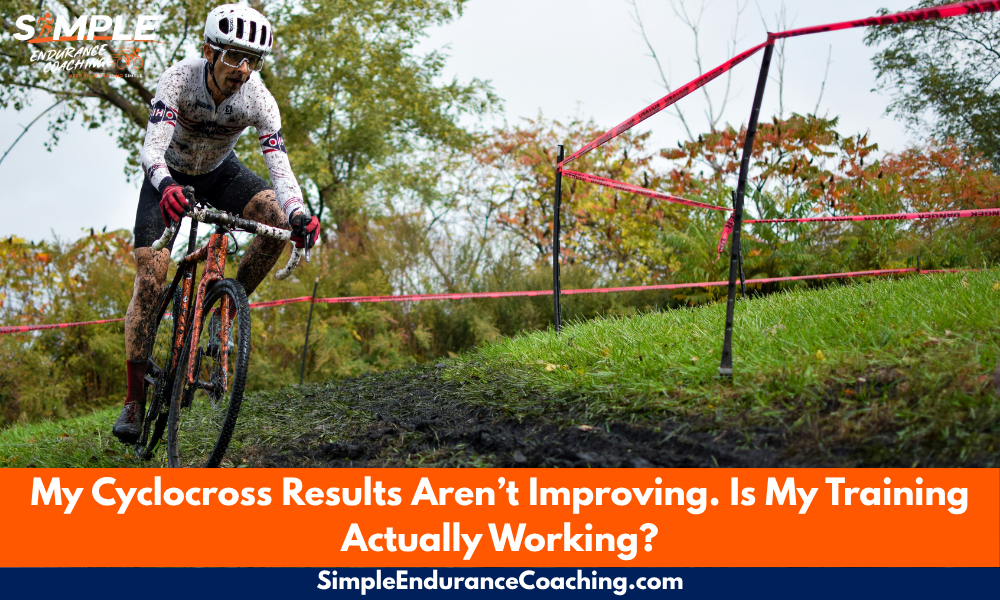
Cyclocross season creates a unique training dilemma.
You spent months building endurance, increasing your FTP, and improving your aerobic fitness. Now races are here.
Should you keep doing threshold intervals?
Should every workout become all-out VO2max suffering?
Or is racing every weekend enough intensity?
Many masters athletes either keep doing the same workouts they used all summer or chase exhaustion with harder and harder intervals. Both approaches usually leave them tired instead of fast.
The solution isn’t doing more intensity.
It’s doing more specific intensity while keeping enough freshness to actually race well.
The closer you get to your goal races, the more your workouts should resemble the demands of cyclocross.

Why Cyclocross Requires Different Workouts
Cyclocross isn’t a steady FTP effort.
Instead, races are full of repeated accelerations.
You sprint off the start.
Accelerate out of nearly every corner.
Jump over barriers.
Run up steep hills.
Recover for only a few seconds before doing it again.
Research on repeated sprint training consistently shows these repeated maximal efforts improve repeated-sprint ability, change-of-direction performance, aerobic fitness, and fatigue resistance—all qualities that transfer well to cyclocross.
That doesn’t mean FTP becomes unimportant.
It means your FTP work has already done its job.
Now you need to teach your body how to use that fitness in race situations.
The Foundation Still Matters
Before discussing race-specific workouts, remember one important principle.
You don’t stop riding endurance miles.
Many athletes make the mistake of replacing all endurance riding with one-hour suffer sessions.
After several weeks they feel flat, struggle late in races, and lose the aerobic fitness they spent all summer building.
A weekly endurance ride—even if it’s only two or three hours—helps preserve your aerobic base throughout the season.
Think of endurance as maintaining the engine.
The interval workouts teach you how to use it.
Workout #1: Soccer Field Sprints (My Favorite Cyclocross Workout)
If I could only prescribe one cyclocross-specific workout, this would probably be it.
Find a soccer field.
Sprint hard down one sideline.
Ride around behind the goal.
Coast for a few seconds.
Sprint back up the opposite sideline.
Repeat.
The recovery is just long enough to prepare for the next acceleration—but never long enough to fully recover.
Sound familiar?
That’s cyclocross.
How to Progress the Workout
Week 1
- 4 × 4 minutes
Week 2
- 4 × 6 minutes
Week 3
- 4 × 8 minutes
Continue extending the intervals until the total work in each set approaches your expected race duration.
If your local races last 45 minutes, eventually your intervals should begin approaching that demand through fewer, longer sets.
This workout develops:
- explosive accelerations
- repeated sprint ability
- corner exits
- bike handling
- pacing under fatigue
- race-specific fitness
Even better, it forces you to practice accelerating while already tired—the exact skill that often determines positions in cyclocross.
Workout #2: Over-Unders with Sprints
Cyclocross rarely lets you sit comfortably at threshold.
Instead, you constantly move above and below it.
Try:
10 minutes
- 2 minutes just below threshold
- 20-second sprint
- Return immediately to threshold
- Repeat every two minutes
This teaches you to recover without actually recovering.
Exactly what happens during a race.
Workout #3: Short Hill Repeats
Find a hill that takes roughly 30 to 60 seconds to climb.
Attack it hard.
Ride easily back down.
Repeat eight to 12 times.
If possible, include a dismount, run-up, or tight corner at the bottom.
The goal isn’t simply power.
It’s learning to produce power after technical sections.
Workout #4: Skills Under Fatigue
Fresh skills are easy.
Race-day skills aren’t.
Finish an interval workout with:
- remount practice
- barrier dismounts
- tight cornering
- off-camber turns
- sand or mud riding
Your coordination changes dramatically once fatigue builds.
That’s exactly when mistakes happen in races.
When Should You Stop Doing FTP Workouts?
Not immediately.
Early in the season, one threshold workout every week or two helps maintain the aerobic fitness you’ve already built.
But as your important races approach, FTP intervals become less valuable than workouts that simulate racing.
Instead of asking,
“How can I raise my FTP?”
Start asking,
“How can I use the fitness I already have?”
That’s a much better question during cyclocross season.
What About Tapering?
Here’s where many athletes make another mistake.
They stop intensity altogether.
The result?
Their legs feel stale instead of fresh.
Research across endurance sports consistently shows that the best tapers reduce overall training volume while maintaining training intensity.
Fitness is preserved while fatigue declines, allowing athletes to perform at their best.
Even repeated-sprint athletes generally maintain or slightly improve performance after a short taper when intensity is preserved.
For your biggest races—state championships, regional championships, or Nationals—you don’t want to eliminate intensity.
We’ll do a blog post about tapering later in the season.
You want to reduce the amount of intensity.
For example:
- Shorter interval sessions
- Fewer repetitions
- More recovery
- Plenty of easy riding
The goal is arriving with fast legs, not tired legs.
We’ll dive deeper into tapering for championship races in a future article.
Putting It All Together
The best cyclocross workouts aren’t necessarily the hardest workouts.
They’re the ones that prepare you for what actually happens during a race.
As the season progresses, gradually shift your training from building fitness to expressing fitness.
Maintain your endurance.
Keep one quality interval session each week.
Practice skills while fatigued.
And don’t be afraid to reduce training volume before your most important races.
Your summer fitness built the engine.
Now it’s time to learn how to race it.
Three Things You Should Know About Cyclocross Workouts
1. Specific beats hard.
The best workouts mimic the repeated accelerations, technical skills, and recovery demands you’ll face every weekend.
2. Don’t abandon your aerobic base.
A weekly endurance ride helps maintain the fitness that lets you finish races as strongly as you start them.
3. Reduce volume—not intensity—before important races.
A proper taper keeps your legs sharp by cutting back on workload while preserving race-specific intensity.
Need More?
Sign up for our free weekly newsletter where you’ll get these articles, plus links to our Athlete’s Compass podcast and other training tools.
Unlock the secrets to mastering gravel racing with our FREE Guide to Gravel Racing! Get yours here.
BOOK A DISCOVERY CALL so we can discuss your goals, answer questions, and talk about making your endurance training more effective, fun, and Simple.
Paul Warloski is a:
- USA Cycling Level 1 Advanced Certified Coach
- RRCA Running Coach
- Training Peaks Level 2 Coach
- RYT-200 Yoga Instructor
- Certified Personal Trainer
- Certified Nutrition Advisor