by Coach Anthony James
Great climbers aren’t just strong, they’re prepared, precise, and efficient.
Hill climbing success comes down to three pillars: structured training, smart execution, and consistent fueling.
But there’s one piece riders often overlook…
Strength training is non-negotiable.
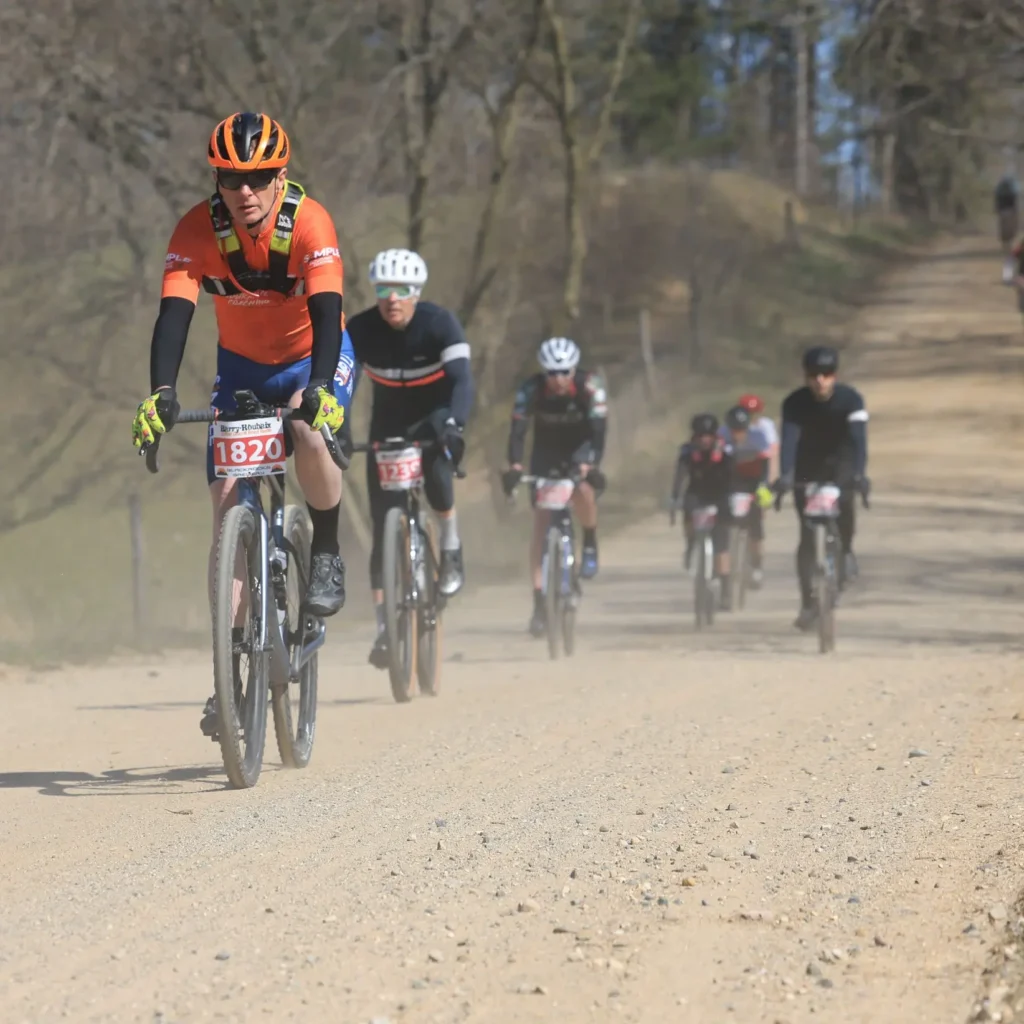
Let’s talk about how to build complete climbing performance from the gym to the dirt road, pavement, and mountain bike trail.
Build the Engine: Strength Training (Non-Negotiable)
Climbing is all about force production over time.
If you want to improve your power-to-weight ratio, you must first improve your ability to produce force.
Here are a couple of examples of work strength sessions.
Strength session #1: Foundational Power Session
Focus: Build raw strength and climbing-specific muscle recruitment
- Back Squats – 4 x 5
- Romanian Deadlifts – 3 x 6–8
- Bulgarian Split Squats – 3 x 6 each leg
- Step-Ups (knee-height box) – 3 x 8 each leg
- Plank Hold – 3 x 45–60 sec
Why it matters:
This workout develops your glutes, quads, and posterior chain—the primary drivers on climbs.
Strength Session #2: Stability + Muscular Endurance
Focus: Improve durability and fatigue resistance
- Split Squats – 3 x 8 each leg
- Single-Leg Deadlifts – 3 x 8 each leg
- Leg Press (moderate load) – 3 x 12–15
- Calf Raises – 3 x 15–20
- Core Circuit (Dead bugs, Russian twists, side planks) – 2–3 rounds
Why it matters:
Climbing isn’t just strength—it’s the ability to hold form and produce power under fatigue.
Perform these sessions 2x per week alongside your riding. This is foundational for better climbing—no shortcuts.
Train for the Demands of Climbing
Once strength routine is in place, you need to develop climb-specific fitness in Zone 4 and above.
Key Effort Targets
Use FTP or RPE to guide your efforts:
- ~30 min climbs
→ ~90% FTP
→ Start RPE 6–7 → finish RPE 9 - Upper Zone 4 (15–20 min)
→ RPE 8 → finish RPE 9 - Lower Zone 5 (5–10 min)
→ RPE 9 - Upper Zone 5 (3–5 min)
→ Sustained RPE 9
Golden rule:
Always start easier than you think and build to empty the tank at the end
Structured Workouts (6–8 Weeks)
Aim for 2–3 key sessions per week.
Climb Simulation Workout
- 2 hours of total riding
- Warm-up: 15–20 min
- 2 x 20-30 sec sprints
- 2 x (10 min @ threshold + 2.5 min VO2 + 7 min recovery)
- Goal here is to keep adding intervals to reach up to about 40-45 min of efforts, then start making them longer in time with fewer intervals.
- Close out with Endurance riding + cooldown
Over-Unders (Mix these up how you like simulate the climb(s) coming up

- 2 hours of total riding
- Warm-up: 15–20 min
- 2 x 20 sec sprints
- Main set:
- 4 x 10 min
- 4 x (1 min @ VO2 + 2 min Threshold)
- 3.5 min recovery
- 4 x 10 min
- Close out with Endurance riding + cooldown
- Goal here is to keep adding intervals to reach up to about 40-45 min of efforts, then start making them longer in time with fewer intervals.
Prepare with Strategy: Know the Climb Before You Ride
Ask yourself:
- Will it be windy?
- Where are the steep pitches and how long are they?
- How long is the climb?
- Any flats or descents?
- Total elevation gain?
Understanding the profile helps you allocate effort correctly.
Execute Smart: Climb Fast, Not Hard
The goal is not peak power, it’s fastest time overall.
Terrain-Based Pacing
- Steep sections: Push a bit harder (10-20 watts)
- Flatter sections: Ease slightly but keep pressure on the pedals (micro recovery)
- Over the top: Focus on carrying your momentum forward to the next steep section or portion of the hill
Wind Strategy
- Headwind: Push a bit harder (10-20 watts)
- Tailwind: Ease slightly, let the wind push you for free speed and use a slight recovery section
These micro-adjustments create free speed and recovery moments that add up.
Ride Dynamically
- Get out of the saddle on steep pitches
- Shift muscle recruitment to stay fresh
- Always ask:
If I push harder here, where can I recover later on the climb?
Long Climb Execution
For sustained long climbs:
- Pace conservatively early
- Use your historical and current training data and power durations as a guide
- Stay disciplined
If possible:
- Take advantage of drafting opportunities on long climbs
Fueling: The Performance Multiplier
Fueling is often the difference between finishing strong and fading hard.
Fuel Early and Consistently
Short Aerobic Rides (<90 min)
- 45–70g carbs/hr
- 16–24 oz fluids/hr
- Electrolytes as needed
Hard / Long Ride with Intervals (>90 min, Z4+)
- 70–100g carbs/hr
- 24–32 oz fluids/hr
- 16–28 oz electrolytes/hr
Adjust based on:
- Heat
- Sweat rate
- Ride intensity
Practice this in training—not just on big days.
And we are all different but you will need to practice and fuel to your composition.
Consistency Builds Great Climbers
Focus on:
- Increasing interval duration
- Improving repeatability of hard efforts
- Riding long with fatigue in mind
And most importantly: Keep showing up consistently
Final Takeaways
Strength (Non-Negotiable)
- Train lower body twice per week
- Build both power and durability
Train
- Focus on Zone 4–5 efforts
- Simulate real climbing demands
Prepare
- Plan effort before you start
- Study terrain, gradient, and wind
Execute
- Adjust effort with terrain and conditions
- Climb fast—not just hard
Fuel
- Eat and drink consistently
- Match intake to effort
Big Picture
The strongest climbers win because they combine:
- Strength from the gym
- Precision from structured training
- Strategy on the climb
- Discipline in fueling
Put it all together, and hills become your advantage—not your weakness.
Coach Anthony James is a USA-Cycling Level 3 coach based in Arkansas. He specializes in mountain bike training and skills work as well as gravel racing. He can be reached at [email protected].