by Coach Paul Warloski
If you’re serious about getting fitter, faster, and stronger, whether that’s for your next gravel race, trail run, or cyclocross race, your sleep might be the most powerful training recovery tool you have.
We know that sleep is when your body repairs muscle, balances hormones, restores glycogen, and consolidates motor skills you worked on in training.
But new research from WHOOP and a peer-reviewed study in Sleep (2024) suggests something surprising: better sleep actually starts in the morning.
What you do in the first few hours after you wake up might dramatically influence how well you sleep at night and how effectively your body recovers from training stress.
The Study: How Four Simple Habits Improved Sleep and Recovery
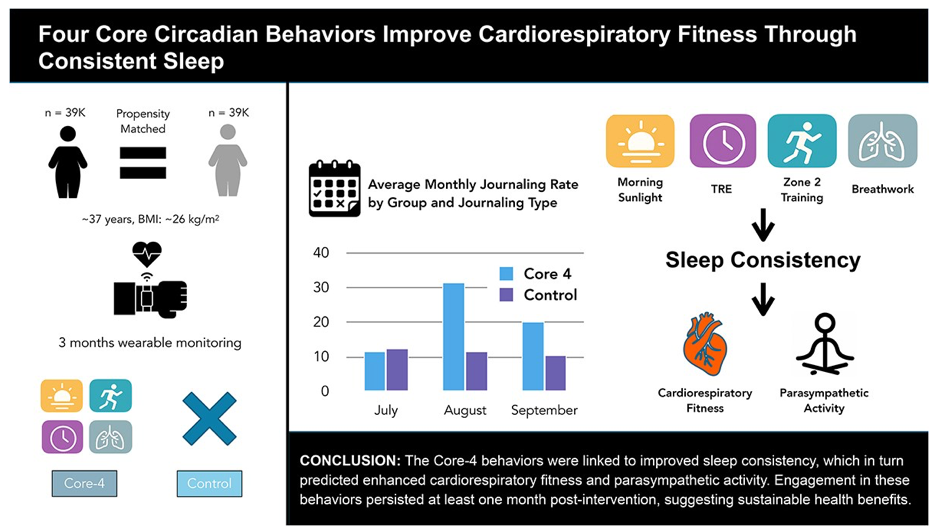
Researchers analyzed data from over 38,000 participants wearing WHOOP devices during a month-long “Core Four” challenge.
They looked at how adopting four daily habits affected sleep quality, recovery, and consistency.
The four habits were:
- Get morning sunlight exposure. Just 10 minutes of natural light soon after waking helps set your circadian rhythm — your body’s internal clock that controls sleep and hormone cycles.
- Eat within a 12-hour window. Keeping meals inside a consistent timeframe (like 7 a.m. to 7 p.m.) supports metabolic rhythms that align with better sleep.
- Do regular aerobic training. Zone 2 endurance sessions — the bread and butter for cyclists, runners, and triathletes — help reduce overall stress hormone levels and promote better recovery.
- Practice five minutes of breathwork daily. Slow, deep breathing activates your parasympathetic nervous system — the “rest and recover” side that primes your body for better sleep.
The study didn’t look at the effects of HIIT or strength training.
After 31 days, participants showed:
- More consistent bedtimes and wake times
- Improved sleep quality and duration
- Lower resting heart rate and higher HRV, a clear sign of better recovery
Even better?
Most participants maintained their habits a month after the challenge ended.
Why This Matters for Everyday Endurance Athletes
You already understand the importance of balancing training stress and recovery.
But for many athletes juggling work, family, and early-morning workouts, sleep consistency often falls apart, and that’s where performance gains are lost.
When your sleep schedule is irregular, your body’s recovery systems, hormones, nervous system, and muscle repair, all run out of sync.
You might be logging the miles, but your adaptations aren’t keeping up.
Here’s how these simple habits might help:
- Morning light sets your clock. Getting light early in the day tells your body when to be alert and when to wind down later. If you train early outdoors, you’re already doing this right.
- Time-restricted eating reduces “night-time alertness.” Late-night snacking keeps your metabolism active when it should be resting.
- Easy aerobic work supports your circadian rhythm. Moderate rides or runs lower cortisol and promote a calmer nervous system.
- Breathwork helps you shift into recovery mode. A few minutes of controlled breathing, especially before bed, can reduce pre-sleep stress and improve sleep onset.
These are all small, free, and sustainable changes, and they directly affect how well your body absorbs training.
Why Sleep Consistency Is as Important as Sleep Quantity
It’s easy to focus on “getting eight hours,” but when you sleep matters too.
The WHOOP data showed that athletes who went to bed and woke up at roughly the same time every day recovered better than those who didn’t, even when total sleep time was the same.
Consistency helps your circadian rhythm regulate hormones like melatonin and cortisol.
That means your body knows when to release energy, when to repair, and when to sleep deeply.
For endurance athletes, that translates into:
- Better muscle recovery
- More stable heart-rate variability
- Improved mood, focus, and motivation for training
Better sleep isn’t about doing more. It’s about building small, consistent habits that help your body recover fully — so every workout actually makes you stronger.
Three Things To Know About Improving Your Circadian Rhythms
- Start your sleep in the morning. Get outside for 10 minutes of natural light soon after waking to anchor your body clock.
- Keep your rhythm consistent. Aim for steady wake and bedtimes, eat in a 12-hour window, and avoid heavy food or screens late at night.
- Train your recovery, not just your fitness. Easy aerobic work and short breathwork sessions help your nervous system reset — leading to better sleep and stronger adaptations.
Need more?
Unlock the secrets to mastering gravel racing with our FREE Guide to Gravel Racing! Get yours here.
BOOK A CALL so we can discuss your goals, answer questions, and talk about making your endurance training more effective, fun, and Simple.
Paul Warloski is a:
- USA Cycling Level 1 Advanced Certified Coach
- RRCA Running Coach
- Training Peaks Level 2 Coach
- RYT-200 Yoga Instructor
- Certified Personal Trainer
- Certified Nutrition Advisor