by Coach Paul Warloski
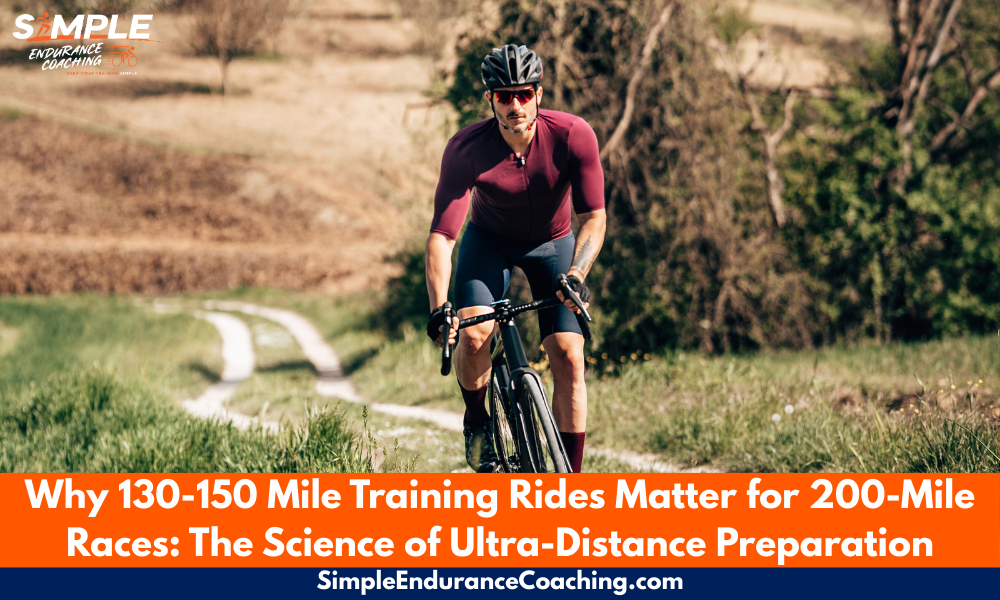
When you’re staring down a 200-mile gravel race like Unbound, your longest training ride isn’t just mileage; it’s scientific preparation for the biggest physical and mental challenge of your season.
While I couldn’t find specific research on long gravel events, here’s what the latest research on ultra-endurance performance reveals about why your 130 to 150-mile rides are absolutely critical.
The Physiology of Going Long: Your Body’s Real Challenges
Recent research published in Sports Medicine (2024) on ultra-endurance running reveals that fatigue in events over six hours is fundamentally multi-factorial, meaning both your body AND mind hit barriers simultaneously.
Here’s what actually breaks down:
1. Thermoregulation Becomes Critical
Your core temperature regulation starts failing around the 4-6 hour mark, regardless of fitness level. The research ssuggest that maintaining a sustainable core body temperature becomes more important than cardiovascular fitness in ultra-events.
2. Gastrointestinal Issues Affect Everyone
Studies show GI distress impacts nearly every ultra-endurance participant. The research recommends progressive gut training and low-FODMAP diet approaches, meaning your long rides aren’t just about fitness, they’re about building digestive resilience.
3. Energy Systems Hit Different
Your body shifts from carbohydrate-dependent to fat-oxidizing metabolism around the 3-4 hour mark. The research supports moderate-to-high carbohydrate intake (60% of calories, 5-8g/kg/day) during training to maintain performance while building fat-burning capacity.
The Psychology of Ultra-Distance Racing
The research reveals something crucial: psychology plays a vital role in ultra-performance, with goal setting (both long and short-term) directly improving outcomes.
Your brain starts playing tricks around hours 6-8.
The research shows that perceived effort has a major impact on your ability to continue at a given pace, often more than actual physiological limitations.
Key psychological strategies from the science:
- Even pacing strategy prevents psychological overwhelm
- Specific goal setting (both season and segment goals) improves performance
- Mental preparation for complex, unexpected situations is essential
The Science-Backed Fueling Strategy
The International Society of Sports Nutrition Position Stand provides specific recommendations for ultra-distance events:
For your 130-150 mile training rides, practice these numbers:
- Calories: 150-400 kcal/hour from a variety of calorie-dense foods
- Carbohydrates: at least 30-50g/hour (your body’s processing limit for sustained efforts)
- Protein: 5-10g/hour (supports recovery during long efforts)
- Fluids: 450-750ml/hour (150-250ml every 20 minutes)
- Sodium: >575mg/L in hot conditions (higher than most commercial products)
Critical insight: The research emphasizes progressive gut training.
You can’t just wing fueling on race day.
Your digestive system needs training to handle these loads while cycling.
Why 130-150 Miles Specifically?
Your 130 to 150-mile training ride represents 65-75% of your target race distance.
This isn’t arbitrary; it creates the perfect training stress without the recovery cost of racing 200 miles.
This distance allows you to:
- Test your exact race fueling strategy for 6+ hours
- Experience psychological barriers in a controlled environment
- Dial in pacing for the second half of your longest event
- Build heat acclimation and hydration habits
- Identify GI tolerance limits before race day
Practical Application: Making Your Long Ride Count
Based on this research, structure your 130-150 mile rides to maximize scientific value:
Nutrition Practice:
- Use your exact race-day fuel sources
- Practice consuming at least 30-50g carbs/hour consistently
- Test different textures and temperatures of food
- Identify what works when you’re tired
Pacing Strategy:
- Even or slightly negative split approach (research shows this prevents overwhelm)
- Practice self-talk strategies for the 6+ hour mark
- Use segment goals every 25-30 miles
Environment Preparation:
- Train in similar heat/humidity conditions as your race
- Test your hydration strategy and electrolyte needs
- Practice removing/adding layers during long efforts
The Mental Game: Training Your Brain
The research emphasizes that ultra-performance requires specific long and short-term goal setting.
Use your long rides to:
- Break down the distance into achievable segments
- Identify your personal pain points (where does your mind start wandering?)
- Practice positive self-talk for when things get tough
- Build confidence in your ability to handle 6+ hours of continuous effort
Your 130-150 Mile Ride: The Ultimate Test
This research reveals that successful ultra-distance performance comes from systematic preparation of both body and mind.
Your longest training ride isn’t just about fitness.
It’s about validating every system you’ll need for race day.
The science shows that athletes who properly prepare their fueling, pacing, and mental strategies for distances similar to their goal events have significantly better outcomes.
Your 130-150 mile ride is where all the theory meets reality.
The bottom line: In ultra-distance events, your preparation strategy often determines your outcome more than your fitness level.
Make those longest rides count with intentional, science-based preparation.
Three Things to Know About Preparing for a 200-Mile Gravel Race
1. Ultra-endurance performance is limited by multiple interconnected factors, including body temperature, stomach distress, and psychological barriers—rather than just cardiovascular fitness.
2. Your 130 to 150-mile training rides (65-75% of race distance) are the perfect “dress rehearsal” to validate your exact race-day fueling, pacing, and mental strategies.
3. Progressive gut training and consistent practice of precise fueling targets during long rides are essential because GI issues affect nearly every ultra-endurance participant.
Need More?
Unlock the secrets to mastering gravel racing with our FREE Guide to Gravel Racing! Get yours here.
BOOK A CALL so we can discuss your goals, answer questions, and talk about making your endurance training more effective, fun, and Simple.
Paul Warloski is a:
- USA Cycling Level 1 Advanced Certified Coach
- RRCA Running Coach
- Training Peaks Level 2 Coach
- RYT-200 Yoga Instructor
- Certified Personal Trainer
- Certified Nutrition Advisor