by Coach Paul Warloski
If you’ve raced gravel, you already know how the early miles usually play out.
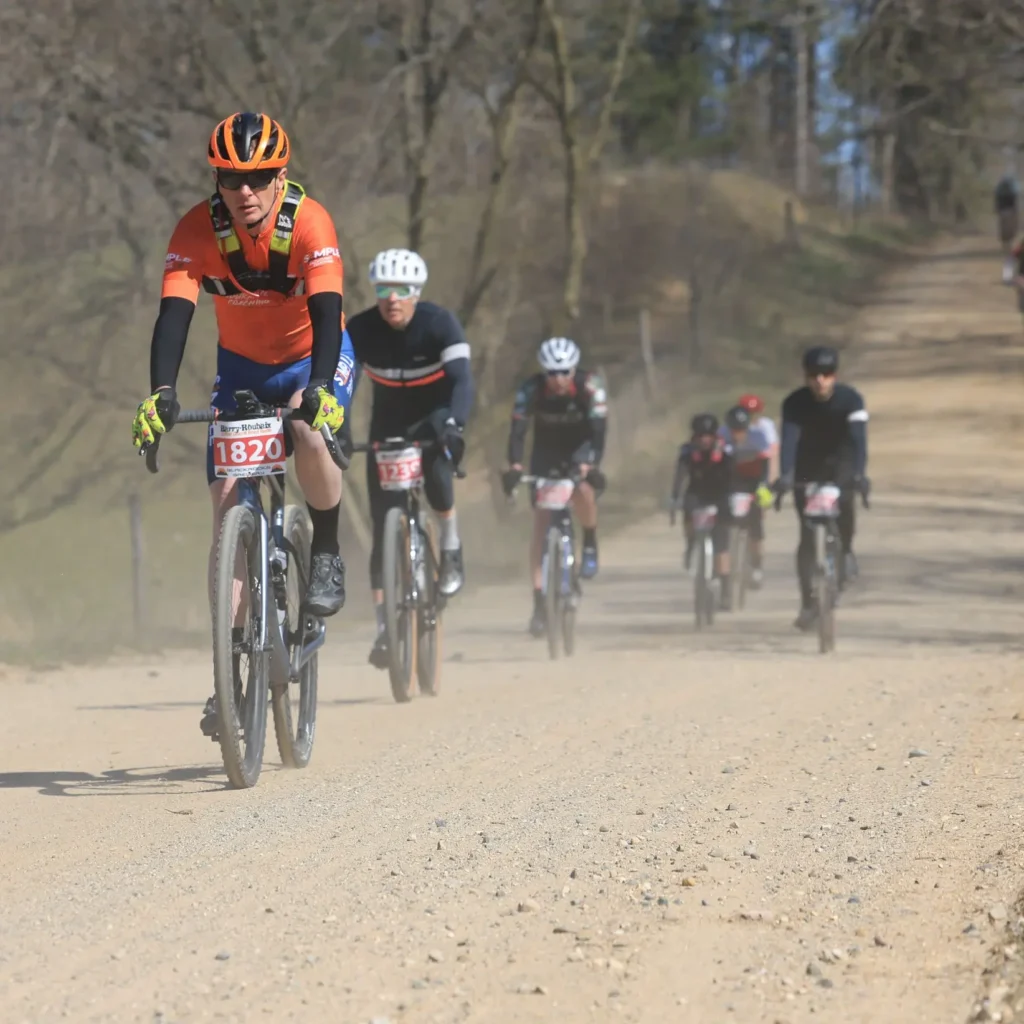
The front group explodes off the line, the strongest riders disappear up the road, and the rest of us settle into smaller groups trying to hold speed and survive the day.
For most racers, success isn’t about riding alone.
It’s about finding the right group and using it wisely.
Understanding when to contribute to the pace and when to conserve energy can make the difference between finishing strong and getting dropped when the decisive move happens.
Why Riding in a Group Saves So Much Energy
Cycling is dominated by one force: aerodynamic drag. At racing speeds, more than 70–80 percent of the energy you produce goes toward pushing air out of the way.
That’s why drafting is so powerful.
Research on peloton aerodynamics shows:
- Riding in the middle of a pack can reduce aerodynamic drag by as much as 95 percent compared with riding alone.
- Even simple drafting behind one rider can reduce energy cost significantly compared to riding solo.
- Riding in a group can save roughly 40 percent of the energy required to ride alone at the same speed.
In practical terms, this means that:
- A rider barely hanging on in the draft might be able to stay with a stronger rider.
- But that same rider would get dropped immediately if forced to ride in the wind.
Researchers studying peloton dynamics describe this as an energy-sharing system.
Riders cooperate by rotating through the front position, but they also compete by trying to spend as little time there as possible.
This dynamic, cooperation mixed with competition, is exactly what you see in gravel race groups.
The First Strategy: Find the Right Group
One of the biggest mistakes riders make is trying to stay in a group that’s simply too strong.
Studies on peloton dynamics show that groups naturally sort themselves by sustainable power output.
Riders with similar capacities end up riding together because drafting allows weaker riders to maintain speed, but only up to a point.
In gravel races, this sorting happens quickly:
- The lead group contains the strongest riders.
- Chasing groups form behind them.
- Eventually riders settle into small packs of similar ability.
Your goal early in the race is simple:
Find the fastest group you can stay in without repeatedly going into the red.
This means riding at a heart rate that is in your tempo or sweet spot zone.
If you’re constantly closing gaps or sprinting to stay attached, you’re in the wrong group.
When to Work vs. When to Hide
This is where tactics become interesting.
There are two competing strategies in any group ride:
1. Cooperation (taking pulls)
2. Free riding (sitting in the draft)
Both strategies have value depending on the situation.
When you should contribute
Working with the group makes sense when:
- You’re trying to catch riders ahead
- The group is stable and cooperative
- You want to drop riders behind
- You’re riding with athletes of similar strength
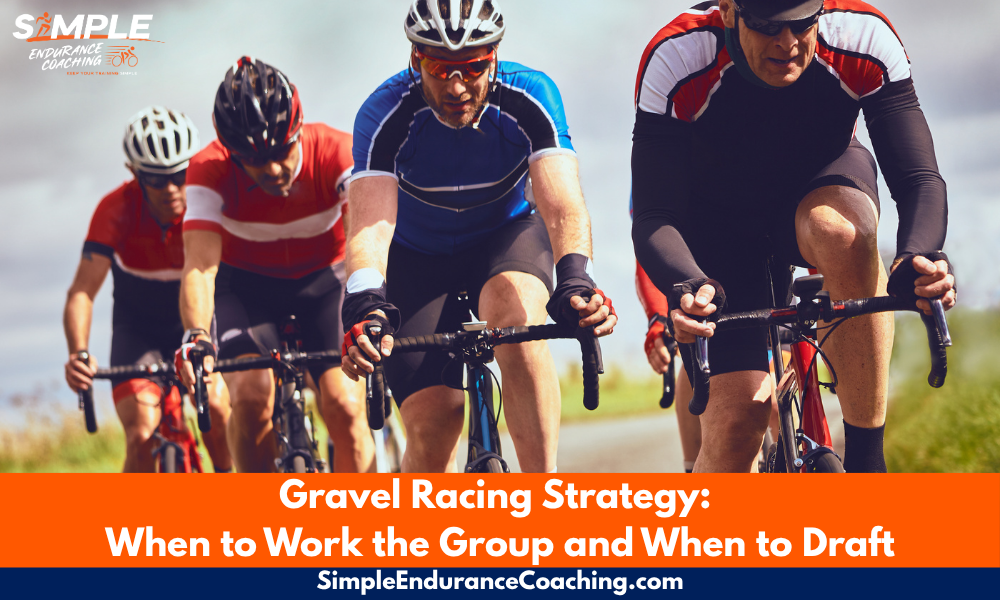
Pacelines work because riders rotate through the wind, sharing the energy cost of the front position.
When everyone contributes, the group moves significantly faster.
Sometimes you stay in the front group as long as you can.
“It is easy to feel good for the first 30-60 min of an event as you sit in a group,” says Anthony James, a coach with Simple Endurance Coaching. “But in reality there is a lot of surging. My thoughts are to watch your HR and keep up the average for the event. If you find your HR average is high over the first hour, then you have to be mindful to sit up. These events are long. If you blow up early you will only go downhill from there. We all tend to push harder than we should for longer in the early parts, not realizing those are matches we can’t get back.”
When you should conserve energy
On the other hand, sometimes the smartest strategy is simply to sit in.
“I am a firm believer of sitting in as much as possible and let others burn matches and try to keep yours for the end or a critical moment later if you know of technical spots on the course,” James says. “Then try to get to the front to either make the split or avoid it.”
You might hide in the draft when:
- The group is already moving fast enough
- You’re near your limit
- Riders ahead are doing most of the work
- You’re saving energy for a decisive climb or attack
Research on peloton dynamics even suggests weaker riders often free-ride intentionally, letting stronger riders do more work while they conserve energy in the draft.
This happens constantly in racing.
And if you’ve ever done a gravel race, you’ve probably thought:
“Why am I pulling when the guy behind me hasn’t touched the wind in 20 miles?”
That’s racing.
Reading the Group
The real skill in gravel racing isn’t just physical—it’s tactical.
Strong racers constantly read the group dynamics.
“My philosophy is if you’re with a group in say 3-10 riders, it’s okay to ride,” adds James. “If more than that, just sit in and do as little work as possible. If you do opt to pull through then just pull through to keep the speed consistent and pull off roll off inside of 15-20 seconds.”
Here are some signals to watch for:
1. Are riders rotating smoothly?
A cooperative group rotates evenly.
If the same riders are pulling every time, the group may break apart soon.
2. Are riders skipping turns?
When multiple riders start skipping pulls, it usually means:
- They’re tired
- Or they’re preparing for attacks
Expect the group to fragment soon.
I’ve often been in numerous groups in longer gravel races because they fragment for these reasons.
3. Is the pace surging?
Surges often signal a selection.
If the pace is smooth, the group may stay together for a long time.
If riders repeatedly accelerate out of corners or climbs, weaker riders will get dropped.
Gravel Racing Adds Another Layer
Gravel races aren’t road races.
The terrain adds complexity:
- Narrow roads
- Loose surfaces
- Rolling hills
- Frequent accelerations
Groups constantly form and split, especially on hills or in gnarly conditions, like single track.
That means the best tactic is often flexibility:
- Work when cooperation helps everyone.
- Hide when conserving energy matters.
- For example, you have to judge how much energy to put into a climb. If you’re feeling good, you might end up dropping your group. Do you want to do that or hold back a little to stay with the group?
And always be ready for the next selection.
Three Things to Know About Group Strategy in Gravel Racing
1. Drafting is incredibly powerful
Riding in a group can reduce aerodynamic drag by up to 95 percent, dramatically lowering the energy cost of maintaining speed.
2. Groups naturally sort by ability
Your job early in the race is finding the fastest group you can realistically stay with.
3. Cooperation and competition happen simultaneously
Working with the group makes everyone faster—but conserving energy may help you later in the race.
Need More?
Unlock the secrets to mastering gravel racing with our FREE Guide to Gravel Racing! Get yours here.
BOOK A CALL so we can discuss your goals, answer questions, and talk about making your endurance training more effective, fun, and Simple.
Paul Warloski is a:
- USA Cycling Level 1 Advanced Certified Coach
- RRCA Running Coach
- Training Peaks Level 2 Coach
- RYT-200 Yoga Instructor
- Certified Personal Trainer
- Certified Nutrition Advisor