Yoga for runners and cyclists improves performance through better balance, strength, breath control, and mobility: a lot of benefits for a short time of work!
Our yoga practice holds poses longer while we focus on breathing.
And that, in turn, helps build strength and mobility.
Yoga for runners and cyclists starts with nose breathing
I always start teaching yoga classes with a focus on my breathing: Inhale through your nose and exhale from your nose.
Generally, start in a seated (Easy pose) position, although you can start in a standing pose (Mountain), or even in Child’s Pose.
Keeping a relatively straight back will help facilitate breathing into your belly. Sometimes it’s also helpful to put your thumb in your belly button and your hand below it, and then push against your hand as you inhale.
Always, though, I’m trying to fill my belly with air, then exhaling back out through my nose.
Sometimes, though, we can exhale through pursed lips.
There are a ton of different ways to breathe in yoga.
I find this method works best to mimic how runners and cyclists breathe during easy runs and rides.
Yoga builds strength in endurance athletes
When we hold a pose like Warrior 1 or Crescent Lunge for 10 to 20 seconds, we create a lot of isometric stress in the forward leg.
That stress translates to building strength in your hip and leg.
No, it’s not the same as using a barbell to do heavy deadlifts, but it’s a great way to build strength without creating as much muscle damage as weight lifting.
And when you hold your arms in the air in Warrior 1 or Crescent Lunge, you build the same kind of isometric stress in your upper body and core.
Doing regular yoga sessions in the off-season and race season is a good way to strength train.
Yoga for runners and cyclists can improve balance for single-leg movements
Anytime you can do single-leg balance poses like Tree, Dancer, or Warrior 3, you not only build the isometric stress, but you train your leg to use stabilizer muscles.
You learn to improve your balance!
Try staring at a spot on the floor or wall and focus solely on your breathing while trying a balance pose.
Tree is a good balance pose to start with since you can easily put the other foot down. I often practice Tree while standing in line at the grocery store!
If you practice with Dancer or Warrior 3, you can practice with a chair or counter in front of you to use your hands.
Mobility can improve with yoga
I want to be careful that we don’t equate yoga mobility with flexibility or stretching.
Yoga mobility is about joint range of motion and your ability to move comfortably in any direction.
So we want to open your hips, allow your spine to move freely, and your shoulders to be loose.
Yoga is a tool to help you improve your running efficiency and form.
The more you are able to allow your body to get into the best possible position for you, the more endurance and speed you’ll find.
We use poses like Warrior 1, not only because of the hip strength of the forward leg, but for the mobility of the opposite hip.
In any of the Warrior poses, your back leg is open sideways, so your hip joint has to move and open.
If you slowly try to open the joint by inhaling and releasing the pose, and then exhaling and deepening the pose, you will gradually increase the range of motion in the joint.
Yoga can help runners and cyclists improve all aspects of their performance
Running and cycling are moving forward in one plane.
- Yoga to build strength improves your ability to control your running stride as well as improve the strength of the single-leg push.
- Yoga to build mobility improves your general movement and your capacity to improve your running form in order to maximize your performance. And it helps cyclists improve full-body strength to drive their legs.
- Yoga for balance helps improve your stability
And maybe most importantly, yoga practice can help your breathing while running or riding. Breathing through your nose is a good sign you’re in your endurance zone, breathing into your belly means you’re utilizing your full breath and getting as much oxygen into the system as possible. And learning to breathe helps moderate and control your effort and concentration during harder efforts. Try counting your breathing the same way you might pay attention to your breathing while moving.
Moving with your breath and holding the pose is the key to building strength, mobility, and breath control
The key to doing this kind of yoga is breathing with your movement.
The thinking comes from research into stretching that suggests that contract and release movement is more effective than static stretching.
So we inhale and relax, exhale and move more deeply into the pose.
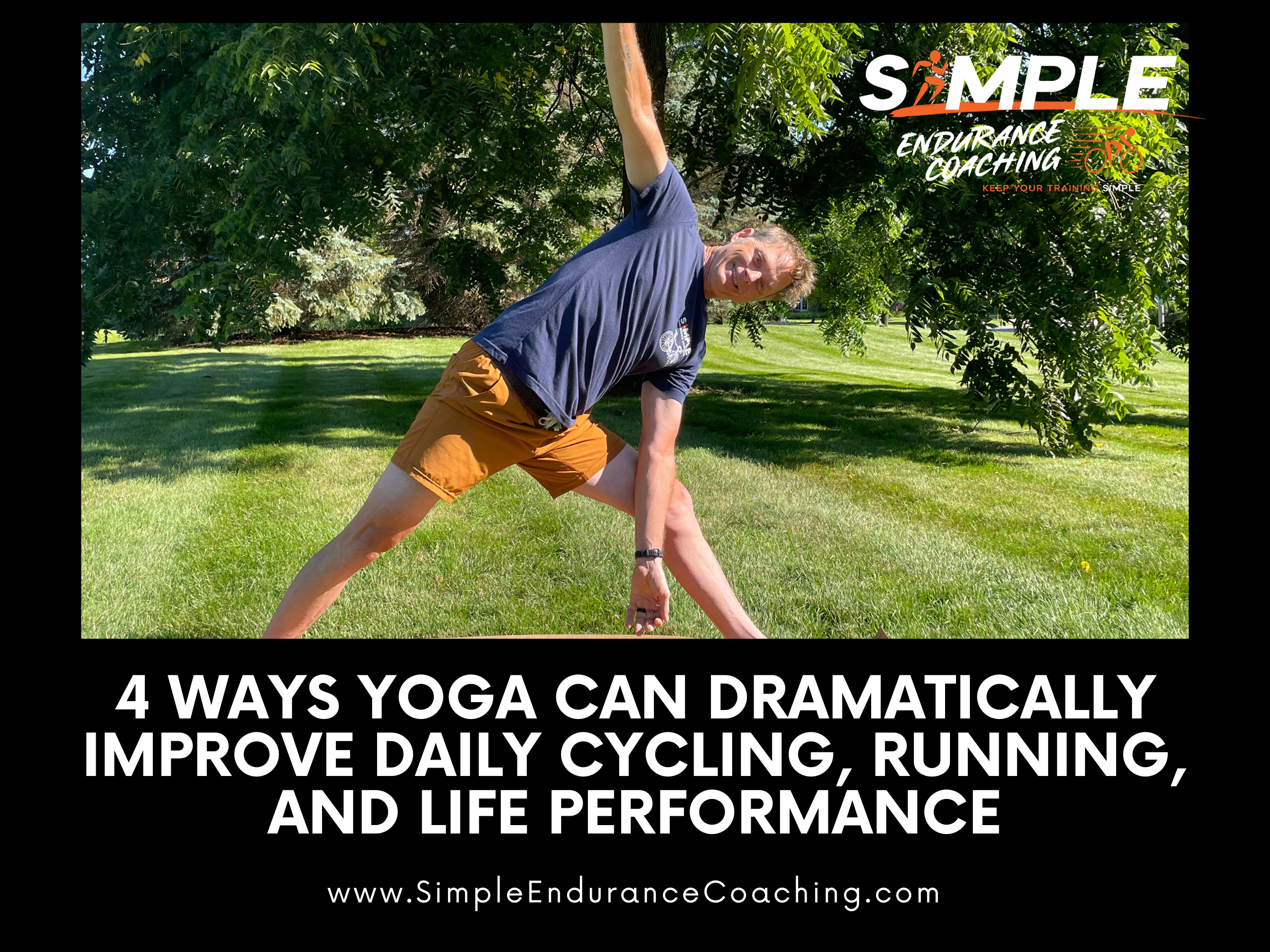
For example, in a Triangle pose, we might drop the upper arm and shoulder on the inhale, breathe into the belly, and open up the torso on the exhale by stacking the top shoulder on the bottom.
With a Downward Dog, come up on your tiptoes on the inhale, and come down on one heel at a time on the exhale. Or bring your collar bones closer to the mat on the exhale.
Keep moving with your breathing without forcing your movement, and you’ll find yourself getting more deeply into a pose than you expected.
Three things to consider about yoga for runners and cyclists
- Focus first on your breathing. Learn to inhale through your nose, fill your belly, and exhale through your nose.
- Always be moving. Work on relaxing in the inhale, deepening the pose on the exhale.
- Use yoga for recovery, building strength, and increase joint range of motion.
Need more?
Unlock the secrets to mastering gravel racing with our FREE Guide to Gravel Racing! Get yours here.
BOOK A CALL so we can discuss your goals, answer questions, and talk about making your endurance training more effective, fun, and Simple.
Paul Warloski is a:
- USA Cycling Level 1 Advanced Certified Coach
- RRCA Running Coach
- Training Peaks Level 2 Coach
- RYT-200 Yoga Instructor
- Certified Personal Trainer
- Certified Nutrition Advisor