Yoga is one of the best things cyclists and runners can do to get stronger and more durable.
Maybe yoga has a bad reputation among older cyclists and runners.
Maybe people perceive it as too new-agey, or they feel like they aren’t flexible enough to even try yoga.
But yoga is simply mobility work that can help cyclists and runners build strength, improve joint range of motion, and increase breathing capacity and control.
Yoga is all about increasing mobility for everyone
First, I teach my yoga classes, particularly the online practice for cyclists and runners, differently than other types of yoga.
I try to incorporate research into mobility and stretching, mobility work for cyclists and runners, and breath practice to help improve performance.
For example, I don’t bring in much yoga spirituality, nor do I treat a yoga class like a workout.
We hold poses for longer than usual while practicing our breathing.
The inhale relaxes the pose, the exhale brings us more deeply into the pose.
And you certainly don’t need to be able to touch your toes or stand on one foot to do yoga.
If you watch my videos, which I’ll link to in the comments section, you’ll see that I’m an awkward older dude who doesn’t look flexible at all!
So don’t worry about being flexible: Yoga is meant for everyone, regardless of your ability to touch your toes.
Yoga for endurance athletes improves breathing
First and foremost, yoga is a breathing practice.
We practice actively inhaling through our noses and into our bellies, then passively exhaling and releasing the breath.
The poses challenge our ability to continue to belly breathe through our nose.
We practice every session by practicing breathing while sitting or standing.
The goal is to breathe into your belly to expand your diaphragm.
Imagine a PVC tube that runs from your nose down your spine to your belly, even into your hips.
Then imagine a balloon attached to the belly end of the pipe
Your goal is to actively inhale through your nose and inflate the balloon.
Then your goal is to passively let the air out of the balloon back through your nose.
So you fill your belly with air, then let it back out, all through your nose.
This breath practice helps you learn how to control your breathing and emotional state.
Nasal breathing can stimulate the vagus nerve, which, in turn, calms your nervous system
Learn to breathe through your nose
Learning how to breathe through your nose is also exactly the kind of breathing we should be practicing while training in the endurance zone.
Nose breathing usually indicates you are still in the endurance zone.
If you have to breathe through your mouth, you’re going too hard.
Of course, you might also have a cold or other chronic nasal congestion!
Sometimes you’ll need to more actively exhale, but belly breathing – and expanding the diaphragm – is the key.
And all the breathing goes through your nose.
There is plenty of research into the value of nose breathing.
And if you can learn how to nose breathe during yoga, you can directly apply that to running or cycling.
Holding a pose builds isometric strength
Holding the poses in our yoga practice provides isometric strength training as well.
For example, we might hold a Warrior 1, one of my favorite poses for cyclists and runners, for several minutes.
In Warrior 1, you dig into your front heel to activate your glutes, which support your body in the pose.
Your torso has to remain straight and upright, requiring core strength.
And your shoulders and arms have to support your upright hands.
So there’s a lot of strength required to hold that pose.
Build stabilizer strength
Plus, there is a lot of stabilizer muscle strength needed in the back leg, which is open and twisted.
As runners and cyclists, we rarely move sideways, with the rare exception of cyclocross and trail running.
Doing strength work that works stabilizer muscles will help us stay upright and move forward.
Also, imagine a Chair pose, where you sit back in a squat, hold up your arms and use your back muscles to stabilize your torso.
Stay in that pose for a minute or two, and you’ll feel your quadriceps and hip muscles start to quiver!
Improve joint range of motion
Another way that yoga helps cyclists and runners is by improving joint range of motion.
Notice I didn’t say improving flexibility because that’s a different thing that may not be a good thing for cyclists and runners.
What we’re trying to do is allow your shoulders, knees, and primarily your hips to function fully and completely.
Joints might be tight or not moving well, and yoga poses help us move in all directions and therefore help our joints move better.
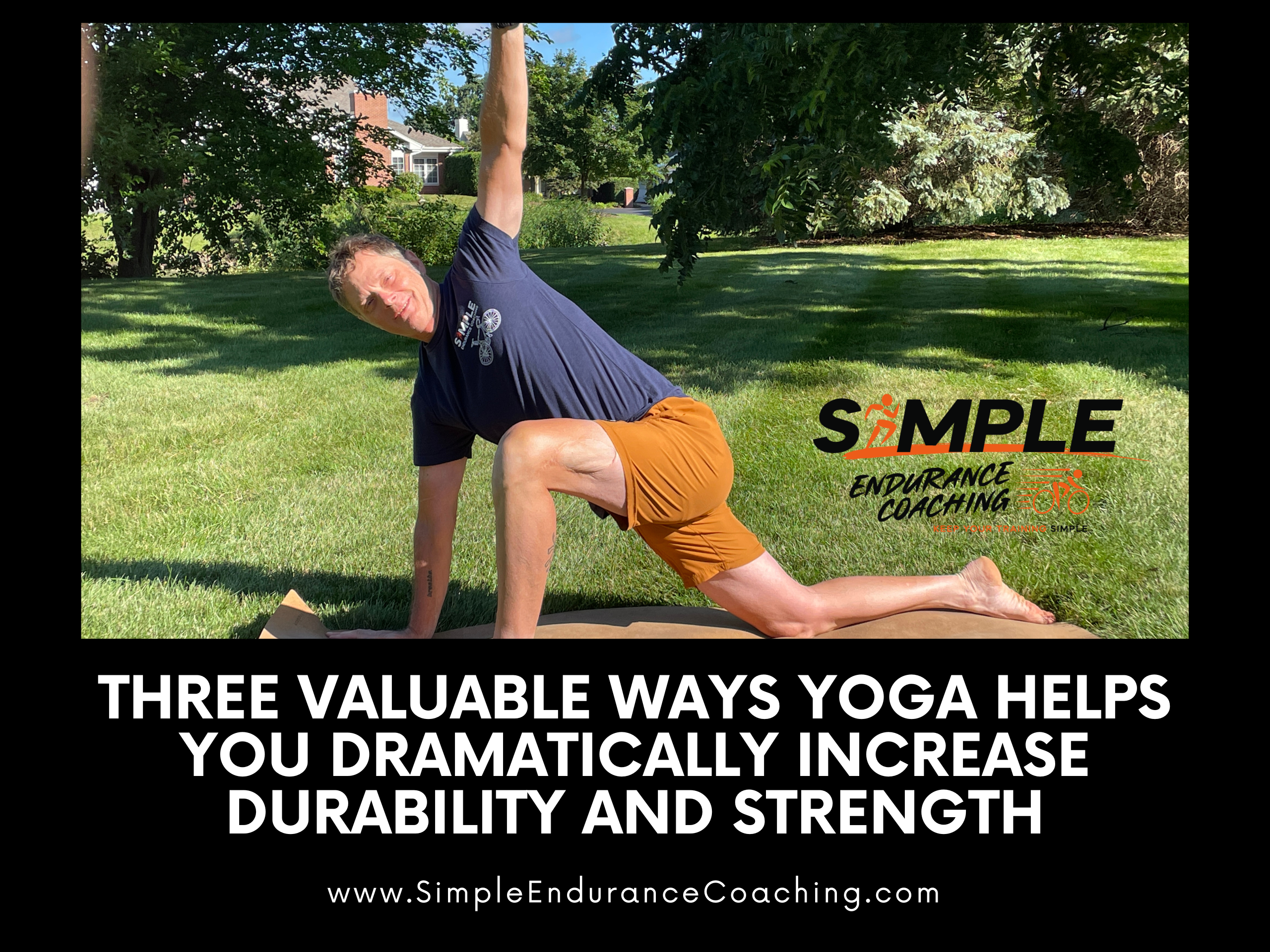
For example, a low lunge or lizard pose with a twist opens your hips and twists your spine.
When we inhale, we let the hips come back and the up arm drop.
Then when we exhale we move the hips as forward and twist as deeply as comfortable.
And with each breath, we try to come more deeply into the pose.
We’re trying to get your hips to move more fully back and forth, as well as your spine to relax and your shoulder to move.
Keep moving in yoga classes
As I’m sure you’re aware, there are a lot of different kinds of yoga: Hot, Flow, Hatha, Yin.
All of them can help with strength and mobility.
For cyclists and runners, I recommend knowing what your goals are in doing yoga: Are you trying to improve your ranges of motion? Are you trying to get stronger? Are you working on recovery?
You certainly don’t want to do a 90-minute hot yoga class, for example, on your recovery day!
For recovery, and for cool downs in Boot Camp classes, we do some gentle movements like Child to Cobra several times, moving with your breathing. Then some Lizard lunge and Twist poses.
What’s important for runners and cyclists, though, is to keep moving in a pose.
Research pretty clearly shows that static hold of a stretch is not the best way to improve mobility.
Here are three things to take away about yoga for runners and cyclists:
- Yoga can help improve joint range of motion if you consciously practice moving with your breathing.
- Yoga can help you practice your nasal breathing, which, in turn, can help calm your nervous system and help with your endurance training.
- Yoga can improve muscular strength, particularly with stabilizer muscles, when you hold poses for several breaths.
Need more?
Unlock the secrets to mastering gravel racing with our FREE Guide to Gravel Racing! Get yours here.
BOOK A CALL so we can discuss your goals, answer questions, and talk about making your endurance training more effective, fun, and Simple.
Paul Warloski is a:
- USA Cycling Level 1 Advanced Certified Coach
- RRCA Running Coach
- Training Peaks Level 2 Coach
- RYT-200 Yoga Instructor
- Certified Personal Trainer
- Certified Nutrition Advisor